
Best ski socks for winter 2026
Best overall: thin merino-blend ski socks for close-fitting boots. Best for recreational skiing: lightly cushioned ski socks. Best for avoiding wool: synthetic ski socks. For winter 2026, choose your on-slope socks by boot fit, then pack a separate cosy pair for après-ski.
- The best ski socks fit your boots without bunching: choose thin merino-blend ski socks as the default.
- Lightly cushioned ski socks suit recreational skiers whose boots have room for targeted padding.
- Synthetic ski socks are the wool-free option; choose a ski-specific shape and cuff height.
- Nordicsockcompany wool winter socks belong in your après-ski kit, not automatically inside close-fitting ski boots.
Why this matters
Ski boots leave much less room for extra fabric than ordinary winter footwear. A lovely thick sock in a walking boot becomes a poor choice when it crowds your toes inside a fitted ski boot.
Warmth starts with a comfortable fit, not the thickest knit. Your sock should sit smoothly, stay in place and extend above the boot cuff. The guide to merino wool socks for skiing covers the material choice; this ranking separates the socks you ski in from those you change into afterwards.
For your 2026 winter trip, make those separate decisions. Buy for the boot first, then choose the cosy pair for the chalet.
What makes the best ski socks?
- Boot fit: The sock must leave your toes comfortable without creating folds around the heel, ankle or forefoot.
- Cuff height: Choose a ski-specific sock that extends above your boot, rather than leaving its top edge beneath the cuff.
- Padding placement: Cushioning should suit the available space. Extra fabric everywhere is not the same as useful padding.
- Material comfort: Merino blends and synthetic ski socks offer different options; choose a fabric your skin tolerates.
- Secure shape: The heel should sit over your heel, and the sock should stay up without needing repeated adjustment.
- Care requirements: Choose socks you can wash and dry according to their label during your trip.
The best ski socks pass all these checks together. A soft fabric does not rescue a poor fit, and a tall cuff does not make a bulky winter sock suitable for every ski boot.
Best ski socks at a glance
The first three choices are on-slope sock categories. The final two are named wool winter socks for time outside your ski boots. That distinction keeps this winter 2026 ranking useful rather than treating every warm sock as interchangeable.
| Rank and option | Best for | Standout feature | Key limitation |
|---|---|---|---|
| 1. Thin merino-blend ski socks | Close-fitting boots and precise fit | Low bulk with a wool-blend construction | Little cushioning for skiers who prefer padding |
| 2. Lightly cushioned ski socks | Recreational skiing with room for padding | Targeted cushioning in a ski-specific shape | Padding still takes up boot space |
| 3. Synthetic ski socks | Skiers who avoid wool | Wool-free material options | Fabric feel varies between blends |
| 4. Ultra Warm Finnish Wool Socks - Black | Cold-weather wear in roomy footwear after skiing | Super-thick wool construction made in Finland | Extra bulk is not a default choice for fitted ski boots |
| 5. Danish Hygge Socks - Sky Grey | Cosy chalet evenings | Winter socks described for staying in and outdoor walks | General winter comfort is not ski-specific construction |
1. Thin merino-blend ski socks: best for close-fitting boots
Thin merino-blend ski socks are the default for a boot that already fits closely. Choose a ski-specific pair with a cuff above the boot and a shape that sits flat around your foot.
The advantage is simple: less fabric competes for space inside the liner. Merino wool is commonly used in outdoor clothing for its moisture-handling properties, but the blend and construction still matter.
Thin merino-blend ski socks pros:
- Low bulk suits closely fitted ski boots.
- A ski-specific cuff keeps the sock edge above the boot.
- Wool-blend fabric offers an alternative to an entirely synthetic sock.
Thin merino-blend ski socks cons:
- Minimal padding does not suit everyone’s comfort preference.
- Wool is not comfortable for every wearer.
- A thin sock cannot correct a badly fitted boot.
Best for: Skiers whose boots feel snug with little room for additional cushioning.
Put thin merino-blend ski socks on before your boot-fitting appointment, not after you have settled on a boot using a much thicker pair. Changing sock thickness changes how the same boot feels.
Verdict: Buy thin merino-blend ski socks as the default for close-fitting boots.
2. Lightly cushioned ski socks: best for recreational skiing
Lightly cushioned ski socks add padding in selected areas rather than making the whole sock thick. Look for the actual cushioning layout, then check how it feels inside your own boots.
This is the useful middle ground for recreational skiers who prefer some softness underfoot or around the shin. Keep the padding modest. Your boot still needs to hold your foot comfortably without squeezing it.
Lightly cushioned ski socks pros:
- Targeted padding provides a cushioned feel where the design places it.
- Ski-specific height keeps the cuff above the boot.
- They offer a middle ground between minimal and bulky socks.
Lightly cushioned ski socks cons:
- Padding reduces the space available inside the boot.
- Cushioning layouts differ, so the category name alone is not enough.
- Extra padding does not fix persistent shin pressure.
Best for: Recreational skiers whose boots comfortably accommodate light cushioning.
For a winter 2026 holiday, try lightly cushioned ski socks with the boots you will actually wear. A comfortable feel in trainers tells you little about pressure beneath a rigid ski-boot shell.
Verdict: Buy lightly cushioned ski socks when your boots have room for the padding.
3. Synthetic ski socks: best for avoiding wool
Synthetic ski socks are the straightforward option when you do not want wool against your skin. Choose an explicitly wool-free composition rather than assuming that a sock described as synthetic contains no wool.
The construction matters as much as the fabric. Look for ski-specific height, a stable heel and a thickness that works with your liner.
Synthetic ski socks pros:
- Wool-free versions suit skiers who prefer to avoid wool.
- Thin and padded constructions offer different fit options.
- Ski-specific designs provide the required cuff height.
Synthetic ski socks cons:
- Different synthetic blends feel different against the skin.
- Wool-free does not automatically mean irritation-free.
- A thick synthetic sock creates the same space problem as a thick wool sock.
Best for: Skiers who want a wool-free on-slope option.
Read the full composition and care label before choosing synthetic ski socks. Material names alone do not tell you how much cushioning, stretch or bulk a particular pair has.
Verdict: Buy synthetic ski socks when avoiding wool is your priority.
4. Ultra Warm Finnish Wool Socks - Black: best after skiing
Ultra Warm Finnish Wool Socks - Black are super-thick wool socks made in Finland. Their product description specifies certified wool yarn and a close, soft fit without scratchiness.
Choose Ultra Warm Finnish Wool Socks - Black for cold-weather wear outside your fitted ski boots, using footwear with room for the extra thickness. Nordicsockcompany wool winter socks are best for travellers who want cosy comfort after skiing.
Ultra Warm Finnish Wool Socks - Black pros:
- Super-thick construction suits a preference for substantial winter socks.
- Made in Finland, with provenance stated in the product description.
- Certified wool yarn and a soft feel are specified.
Ultra Warm Finnish Wool Socks - Black cons:
- The thick knit takes up additional space in footwear.
- They are not the default recommendation for closely fitted ski boots.
Best for: Changing into roomy winter footwear after your last run.
Keep Ultra Warm Finnish Wool Socks - Black separate from your on-slope choice. Their job in this list is cosy winter comfort, not replacing a thin ski sock inside a boot fitted around one.
Verdict: Buy for off-slope winter wear; skip as an automatic ski-boot choice.
5. Danish Hygge Socks - Sky Grey: best for chalet evenings
Danish Hygge Socks - Sky Grey are described for staying in and keeping cosy, as well as crisp outdoor walks and hiking trails. That makes the après-ski part of your holiday their clear place in this guide.
Choose Danish Hygge Socks - Sky Grey when you want a separate winter pair for relaxing after taking your boots off. You do not need to make your chalet socks do the same job as your piste socks.
Danish Hygge Socks - Sky Grey pros:
- The stated use includes cosy time indoors.
- The description also includes outdoor walks.
- A separate pair lets you change out of your skiing socks.
Danish Hygge Socks - Sky Grey cons:
- General winter use is not a reason to select them for fitted ski boots.
- They do not replace a ski-specific pair chosen around boot fit.
Best for: Chalet evenings and relaxed time between skiing days.
Verdict: Buy Danish Hygge Socks - Sky Grey for après-ski; skip as your default on-slope pair.
Check the fit before you pack
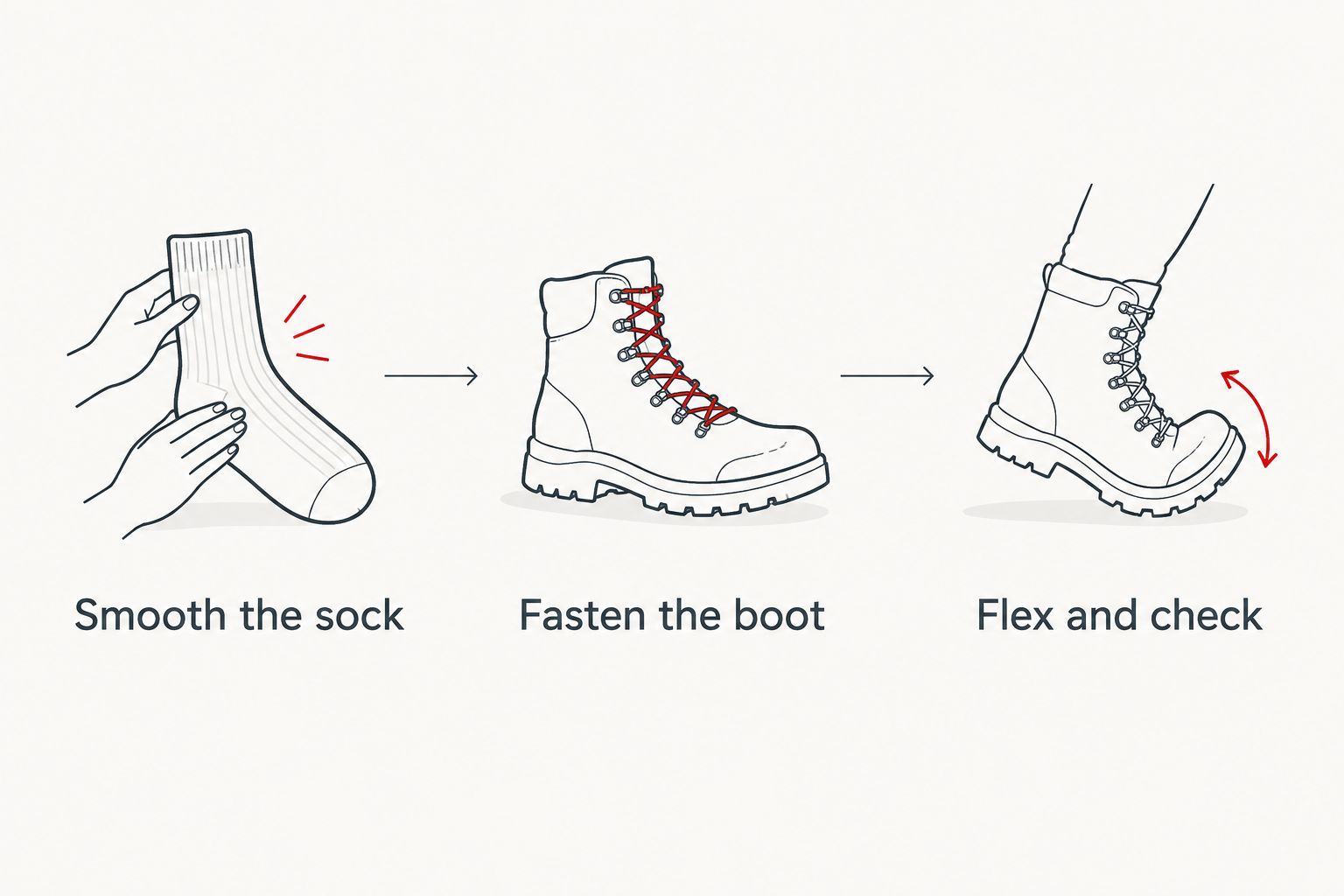
Use these 3 checks for your 2026 ski kit. Test socks with your boots and normal base layers, not in isolation.
- Smooth the sock: Seat the heel correctly and remove folds around the toes and ankle.
- Fasten the boot: Use your usual fastening position and check for concentrated pressure.
- Flex and check: Flex forward, confirm the cuff stays above the boot and check that your toes remain comfortable.
Wear 1 pair of ski socks at a time as your starting point. Adding a second pair changes the fit and creates another layer that can wrinkle. Do not use extra socks to disguise a boot that feels wrong.
For packing, separate 2 roles: skiing and relaxing afterwards. Nordicsockcompany wool winter socks serve the second role in this guide; choose your ski-specific pair around the first.


How these choices are ranked
This ranking puts boot fit before thickness, then considers cuff height, cushioning, material comfort and care. The on-slope recommendations describe sock constructions rather than claiming a tested winner among named technical products.
The named Nordicsockcompany options are ranked for the off-slope uses supported by their product descriptions. Finnish manufacture and a cosy knit are useful facts, but neither establishes suitability for a particular ski boot.
Which ski socks should you choose?
Choose thin merino-blend ski socks if you are undecided and your boots fit closely. Choose lightly cushioned ski socks when you prefer padding and your boots accommodate it. Choose synthetic ski socks when you want to avoid wool.
For winter 2026, keep Ultra Warm Finnish Wool Socks - Black or Danish Hygge Socks - Sky Grey as a separate off-slope choice. That gives each pair a clear job rather than asking one thick winter sock to cover everything.
FAQ
What are the best ski socks for winter 2026?
Thin merino-blend ski socks are the default for close-fitting boots. Choose lightly cushioned ski socks if your boots have room for padding, or wool-free synthetic ski socks if you avoid wool.
Are thick socks better for skiing?
Thick socks are not automatically better for skiing. Extra fabric takes up boot space, so choose thickness by fit rather than assuming the thickest pair will feel warmest.
Should I wear two pairs of socks in ski boots?
Start with one well-fitting pair of ski socks. A second pair changes the fit and adds another layer that can bunch inside the boot.
How high should ski socks come up?
Ski socks should extend above your ski-boot cuff. Avoid placing the sock’s top edge beneath the cuff, where it adds a ridge inside the boot.
Can I use ordinary wool winter socks for skiing?
Do not choose ordinary wool winter socks for skiing on warmth alone. Check cuff height, thickness and fit inside the actual boot; a ski-specific pair is the clearer starting point.
Can I wear Ultra Warm Finnish Wool Socks - Black in ski boots?
Ultra Warm Finnish Wool Socks - Black are not this guide’s default for fitted ski boots because their super-thick construction adds bulk. Choose them for off-slope winter wear in footwear that accommodates the thickness.
Which Nordicsockcompany socks should I pack for après-ski?
Danish Hygge Socks - Sky Grey suit cosy chalet evenings, while Ultra Warm Finnish Wool Socks - Black suit a preference for substantial winter socks in roomy footwear. Keep your après-ski pair separate from the socks selected for your ski boots.
One last thing
Bring your chosen ski socks to the boot fitting. The useful comparison is not how two pairs feel on the sofa, but how each changes the fit of the same boot.
If numbness, pain or persistent pressure appears, stop and get the boot fit checked. Changing to a thicker sock is not a substitute for resolving the pressure.