
Can Wool Socks Be Worn With Psoriasis? 2026 Verdict
Wool socks can be worn with psoriasis-prone skin, provided you pick a fine wool blend and keep it off active, cracked plaques. Most irritation blamed on "wool" actually comes from coarse fibre diameter, tight elastic cuffs, or a bulky toe seam rubbing against already-inflamed skin, not from wool itself.
- Fine merino-blend wool worn over healed or calm skin causes no more irritation than cotton for most people in 2026.
- Coarse wool pressed directly on active, cracked plaques is the usual trigger, not wool as a fibre category.
- Seamless toe construction and a relaxed, non-elastic cuff cut the friction that can start new plaques.
- Nordic Sock Company's Swedish Lagom socks use a soft wool blend built to avoid the scratchy feel that sets off reactions.
- Patch-test any new wool sock on a small patch of skin for 24 hours before wearing it a full day.
Why this matters
People with psoriasis get told to avoid wool altogether, which throws out a warm, breathable fabric over a problem that's really about fibre grade and fit. The skin barrier over a psoriasis plaque is already compromised, so anything that adds friction or heat build-up can slow healing or spark a new patch nearby — a reaction dermatology calls the Koebner phenomenon, where trauma to skin (a scratch, a tight seam, a rubbed patch) triggers a fresh plaque at that exact site.
That's a mechanical trigger, not an allergy to sheep's wool. A guide on choosing wool socks for sensitive skin covers the same logic for eczema and general sensitivity, and the same rules apply here: soft fibre, loose seams, breathable fit.
Can wool socks be worn with psoriasis?
Yes, for most people, most of the time. The deciding factor is which wool you're putting against the skin, not whether it's wool at all.
| Wool type | Typical fibre diameter | Feel against skin | Best for psoriasis-prone feet |
|---|---|---|---|
| Fine merino blend | ~17-22 micron | Soft, minimal prickle | Daily wear, even near calmer patches |
| Standard wool blend | ~24-28 micron | Some prickle on very sensitive skin | Healthy skin, shorter wear |
| Coarse or traditional wool | 30+ micron | Noticeable itch and friction | Avoid directly over active flares |
Fine merino-blend yarn, the kind used in most modern wool socks in 2026, sits well below the prickle threshold that causes reactive itching in sensitive skin. Coarser traditional wool, the kind in old-style hiking socks from decades back, sits above it and is the version most people are actually remembering when they say "wool makes my skin worse."
Why irritation varies
Five things decide whether a wool sock calms a psoriasis-prone foot or aggravates it:
- Fibre diameter — finer fibre bends against skin instead of pressing into it, cutting mechanical irritation
- Seam and toe closure — a bulky toe seam sitting on a plaque site is a common trigger for new Koebner lesions
- Cuff tightness — tight elastic bands compress skin and can mark or irritate already-fragile areas
- Moisture retention — damp feet inside non-breathable synthetic blends soften skin and raise friction; wool wicks moisture away and helps here
- Skin barrier state — active, cracked, or bleeding plaques react to almost anything; calmer, intact skin tolerates far more
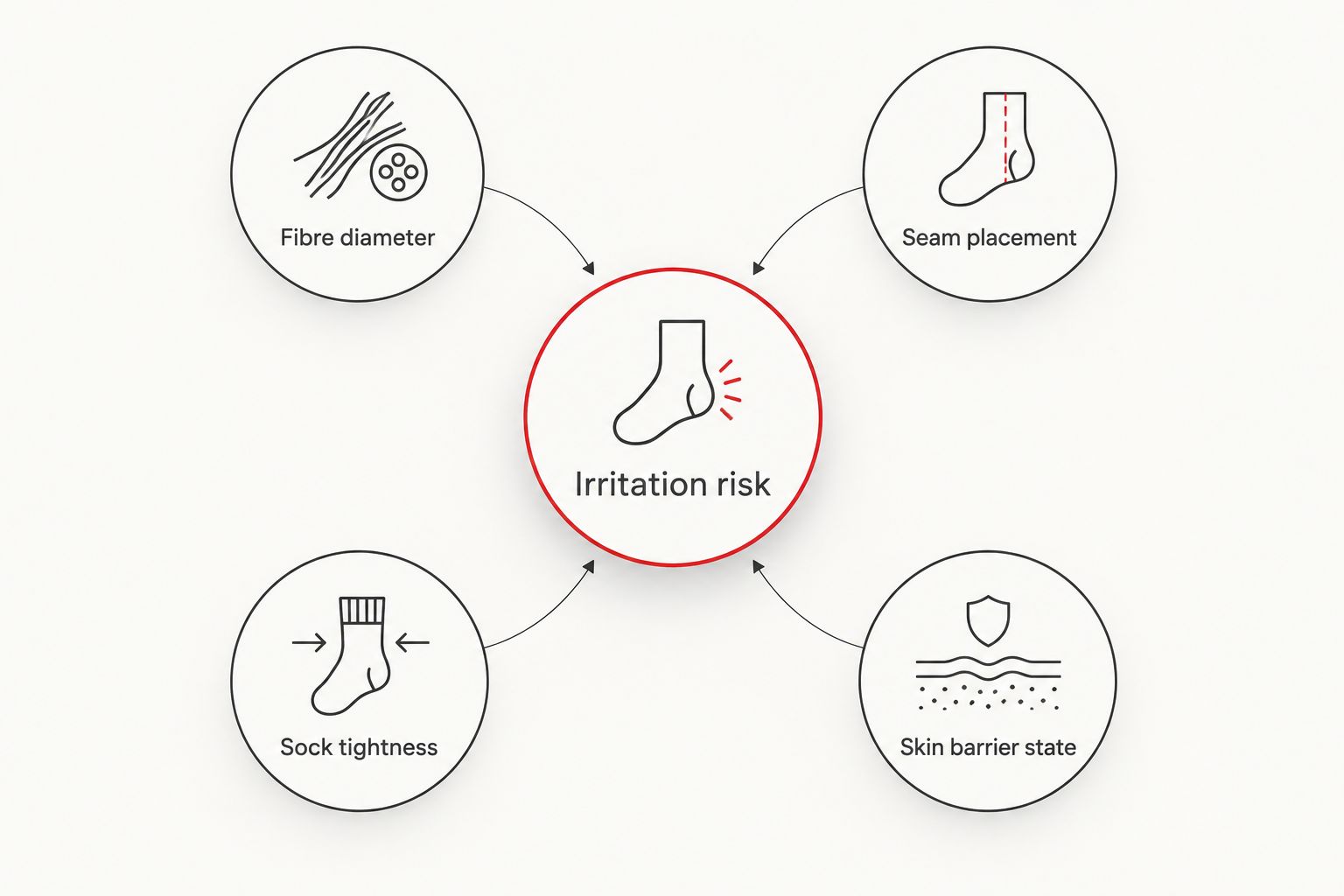
A seam sitting directly over a healing plaque undoes the benefit of a soft yarn, which is why a non-itch wool sock built with a smoother toe closure tends to outperform a technically-softer sock with a rougher seam.
Is merino wool better than regular wool for psoriasis-prone skin?
Merino wool is better for psoriasis-prone skin because its fibre diameter, typically 17-24 micron, sits well below the prickle threshold that causes reactive itching. Regular or traditional wool runs 30 micron and above, which is coarse enough to irritate skin that's already compromised by a flare.
Can wool socks make eczema or psoriasis worse?
Wool socks can make psoriasis worse only when a coarse blend or a rough seam sits directly on active, cracked skin — the trauma itself, not the fibre type, is what can trigger a new plaque through the Koebner phenomenon. A fine wool blend on calmer skin does not carry the same risk.
What's the best sock material for psoriasis on the feet?
The best material for psoriasis-prone feet is a fine wool blend, roughly 17-24 micron, worn with a seamless or low-profile toe and a relaxed cuff. It combines the moisture-wicking and temperature regulation wool offers with a fibre fine enough not to trigger reactive itching, which is why Nordic Sock Company builds its softer lines, including the Swedish Lagom socks, around a pillowy, non-scratchy wool blend rather than a coarse traditional yarn.


“It's the seam sitting on a plaque that starts a new one, not the wool underneath it.”
FAQ
Can people with psoriasis wear wool socks?
Yes, people with psoriasis can wear wool socks, especially fine merino-blend styles worn over calm or healed skin. The main thing to avoid is coarse wool or a bulky seam pressed directly onto an active, cracked plaque.
Does wool make psoriasis worse?
Wool itself doesn't make psoriasis worse; friction and coarse fibre against already-inflamed skin does. A fine wool blend under 24 micron carries far less risk than a coarse, traditional wool sock.
What socks are best for psoriasis on the feet?
The best socks for psoriasis on the feet are fine wool blends with a seamless or low-profile toe and a loose, non-elastic cuff. This combination keeps feet dry and warm without adding mechanical irritation.
Is merino wool hypoallergenic?
Merino wool is not classed as hypoallergenic, but its fine fibre diameter, typically 17-24 micron, sits below the prickle threshold that causes most reactive itching, which is why it's far better tolerated than coarse wool.
Can wool socks trigger a psoriasis flare through the Koebner phenomenon?
Wool socks can trigger a new plaque through the Koebner phenomenon if a seam or tight cuff repeatedly rubs the same spot on already-fragile skin. This is a friction response, not a reaction specific to wool.
Should you wear socks to bed with psoriasis on the feet?
Wearing socks to bed with psoriasis on the feet is fine and can help if your skin cracks in dry, centrally-heated air overnight, as long as the sock is soft, seamless at the toe, and not tight at the cuff.
How do you know if wool is irritating your skin?
Wool is irritating your skin if you notice new redness, itching, or a fresh patch at the exact spot a seam or cuff sits, usually within a day or two of wearing the sock. Switching to a finer blend or removing the sock at that site usually resolves it.
Are seamless socks better for psoriasis-prone feet?
Seamless or low-profile toe socks are better for psoriasis-prone feet because they remove the single most common friction point that sits directly over toe plaques. Combined with a fine wool blend, they cut both chemical and mechanical irritation sources.
One last thing
The detail most people miss is that psoriasis reacts to trauma at a site, not to wool as a category — try wearing a new sock inside out for the first day so the seam sits away from skin entirely, and you'll usually find out within 24 hours whether it's the fibre or the seam causing the problem. If the sock feels fine inside out but irritates the right way round, it's the construction, not the wool, and a seamless style solves it without giving up wool altogether in 2026.