
Heavyweight vs lightweight wool socks: warmer? 2026
Yes—heavyweight wool socks generally add warmth over lightweight wool socks when their extra thickness remains uncompressed inside your footwear. The catch is fit: a thicker sock that crowds your toes or makes your boots tight can work against warm, comfortable feet. Choose heavyweight for cold, low-activity wear with roomy footwear; choose lightweight when boot space or overheating is the bigger concern.
- Do heavyweight wool socks add much warmth over lightweight? Yes, when their extra thickness fits comfortably inside your footwear.
- Heavyweight wool socks suit cold, low-activity wear; lightweight wool socks suit closer-fitting shoes and warmer, active feet.
- Boot fit, trapped air and dampness matter more than choosing the thickest sock available.
- Nordic Sock Company suits shoppers seeking European-made wool-blend winter socks with Nordic styling.
Do heavyweight wool socks add much warmth over lightweight?
Heavyweight wool socks offer more room for insulating air within the fabric. That is the main reason a thicker wool sock generally feels warmer than a thinner, otherwise similar sock. Wool does not generate heat; it helps slow the loss of heat your body produces.
The difference is not a fixed temperature gain. Yarn, knitting, cushioning, moisture and footwear all affect the result, so a heavyweight label alone cannot tell you how warm your toes will feel.
| Sock weight | Best for | Main advantage | Main drawback |
|---|---|---|---|
| Lightweight | Close-fitting shoes and active wear | Less bulk leaves more room inside footwear | Less insulation when other construction details are similar |
| Heavyweight | Cold, low-activity wear in roomy boots or slippers | More thickness can hold more insulating air | Extra bulk can crowd toes or feel too hot during activity |
For your 2026 winter wardrobe, start with the shoes you actually wear, not the thickest sock you can find. The guide to choosing wool sock thickness for winter covers that wider choice.
Why this matters
The warmest-looking sock is not always the warmest choice inside your boots. A comfortable footwear system gives your toes room, keeps your feet reasonably dry and provides insulation around the whole foot—not just beneath it.
That matters when you move between a cold pavement and a heated room. You need enough warmth outdoors without making your feet sweaty indoors; buying extra thickness without checking fit leaves that problem unsolved.
Heavyweight wool socks: best for cold, less active wear
Heavyweight wool socks are the better starting point when you feel cold while sitting or standing and your footwear has space for them. Think of a chilly living room, a winter spectator outing or a slow outdoor stroll rather than a brisk uphill walk.
Their advantage comes from thickness and the air held within the knitted fabric. Cushioning also changes how they feel underfoot, but softness and insulation are not interchangeable: a plush sole does not prove that the entire sock is equally thick.
Check the top of your foot as well as your toes. A sock can fit comfortably around the sole yet make the upper of a shoe press down across your instep. Loosening the laces helps only if the footwear has enough internal space to begin with.
The trade-off is bulk. Heavyweight socks occupy more of the shoe and can feel unnecessarily warm once you start moving hard or spend time in heated buildings. Choose extra thickness for a clear cold-weather need, not as an automatic upgrade.
Lightweight wool socks: best for limited shoe space
Lightweight wool socks are the better starting point when your shoes already fit closely or your feet get hot during activity. Less fabric leaves more room for your toes and reduces the amount of insulation you carry into a warm room.
Lightweight does not mean useless in winter. A thinner sock inside a well-fitting, insulated boot is part of a different system from the same sock inside an uninsulated shoe. Judge the combination, not the sock in isolation.
The limitation appears when you stop moving. A sock that feels comfortable during a brisk walk can feel insufficient while you stand outside afterwards, because your activity level has changed while your clothing has not.
When choosing lightweight wool socks in 2026, look beyond the label. Check whether cushioning is concentrated underfoot, whether the upper is thinner and whether the cuff stays comfortable. Those details tell you more about everyday wear than a weight category by itself.
Why the warmth difference varies
The warmth difference between heavyweight and lightweight wool socks depends on how the sock behaves on your foot, inside your footwear, during your day.
- Fabric thickness: A thicker, otherwise similar fabric provides more space for insulating air. A dense, flattened knit is different from a lofty one.
- Boot fit: Extra thickness needs room. If it makes the toe box or instep tight, the heavier sock is a poor match for that footwear.
- Moisture: Sweaty or wet feet change the warmth equation. Wool's ability to absorb moisture does not make a soaked sock equivalent to a dry one.
- Activity: Walking generates more body heat than sitting still. The same sock can feel comfortable during movement and inadequate during a long pause.
- Footwear insulation: The sole, upper and lining contribute to warmth. Socks cannot compensate fully for unsuitable footwear.
- Knit and fibre blend: Wool content is only part of the construction. Yarn structure, cushioning and the other fibres also affect how a sock fits and feels.
Compare socks under similar conditions before deciding that weight alone explains the difference. Changing your boots, walking pace and sock thickness together makes it difficult to identify what actually improved comfort.
How do you check whether heavyweight socks suit your boots?
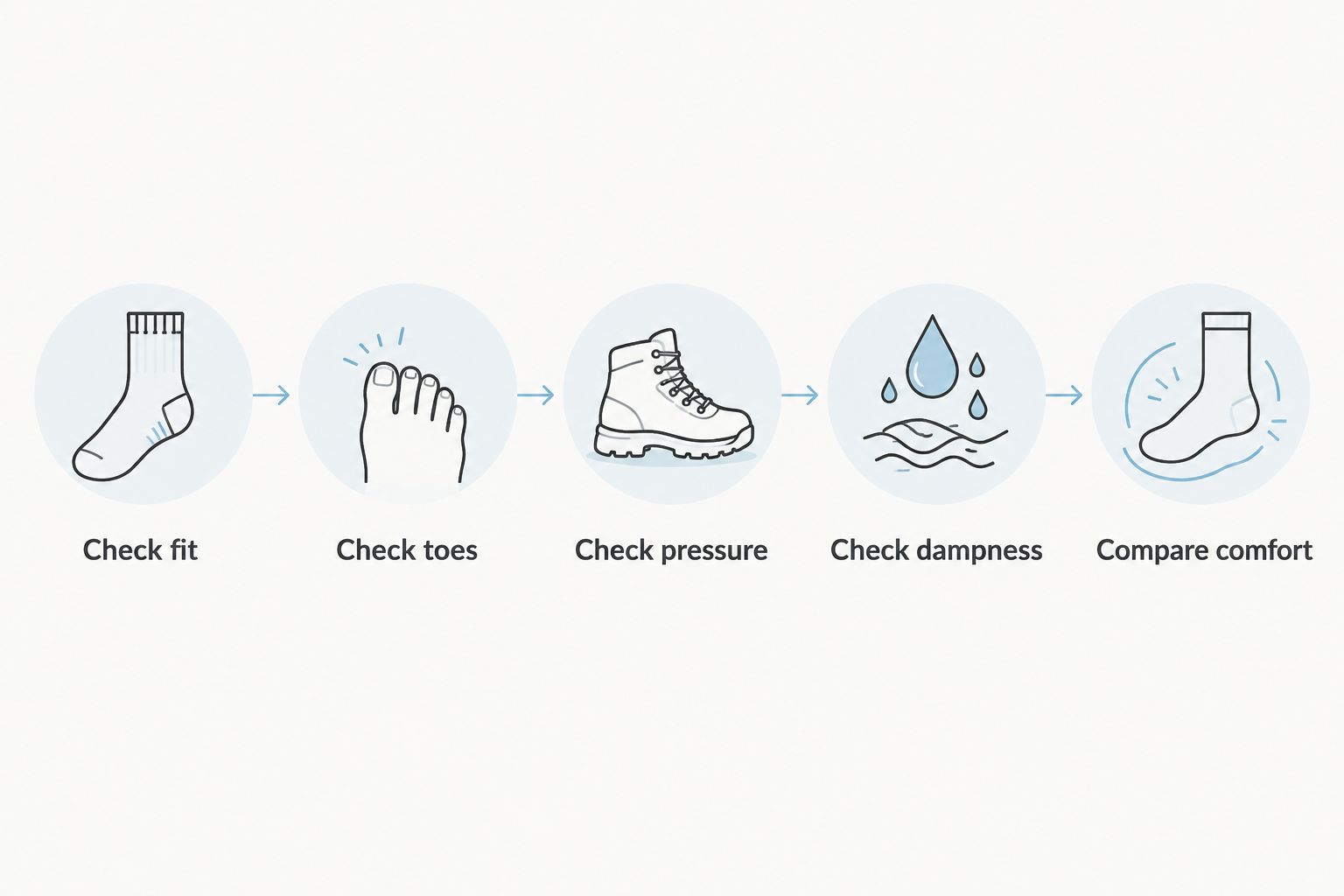
Use this fitting sequence before committing to heavyweight socks for winter 2026. Test them with the footwear you intend to use, rather than judging them while standing in socks alone.
- Check fit. Pull the sock on smoothly, place the heel correctly and remove folds. A bunched sock takes up space and creates pressure that tells you little about its intended fit.
- Check toes. Put on your usual footwear and fasten it normally. Your toes should move comfortably without pressing firmly against the front or sides.
- Check pressure. Stand and walk, then notice the instep, toe joints and cuff. A snug feel is different from squeezing, pinching or numbness; stop wearing a combination that causes discomfort.
- Check dampness. After ordinary use, notice whether your feet feel clammy. More insulation is not a useful improvement if it leaves you uncomfortable during your normal routine.
- Compare comfort. Repeat the check with a lighter pair in the same footwear and similar conditions. Choose the combination that stays warm without pressure or excessive sweating.
The useful result is a clear fit decision, not a homemade temperature rating. Do not stay outside in uncomfortable cold simply to test a sock.
Where do Nordic-style winter socks fit into the choice?
Nordic Sock Company suits shoppers seeking European-made wool-blend winter socks with Nordic styling. Its winter range is relevant when you want cosy everyday footwear, but choose each pair by its stated construction and the space inside your shoes.
These options serve different shopping priorities. The Finnish pair is explicitly described as super-thick; the Swedish pair emphasises soft wool-blend cushioning for everyday winter wear. That is a useful distinction, not a measured head-to-head warmth rating.
| Product | Best for | Stated strengths | What to check before choosing |
|---|---|---|---|
| Ultra Warm Finnish Wool Socks - Black | Shoppers seeking explicitly super-thick winter socks | Made in Finland; certified wool yarn; described as soft and non-scratchy | Super-thick fabric needs enough room inside your footwear |
| Swedish Lagom Socks - Warm Ochre | Shoppers seeking cushioned everyday winter comfort | Soft wool blend; pillowy cushioning; described as non-scratchy | Check thickness and shoe fit rather than treating it as a lightweight alternative |
The advantage of Ultra Warm Finnish Wool Socks - Black is the clear emphasis on extra thickness. The limitation is the footwear space that thickness requires. Swedish Lagom Socks - Warm Ochre offers stated everyday cushioning, but cushioning alone does not establish a warmth category.
For Nordic Sock Company wool-blend winter socks, match the product description to your use, then check fit. A Nordic name or pattern is not a thermal specification.


Are heavyweight wool socks warmer when you stand still?
Heavyweight wool socks generally offer more insulation when you stand still, provided they fit comfortably and remain reasonably dry. The advantage is more relevant during low activity, when you generate less heat than during brisk movement.
Your boots still matter. If cold reaches your feet through an inadequately insulated sole, adding sock bulk alone does not address the whole problem.
Can lightweight wool socks feel warmer in tight boots?
Lightweight wool socks can be the warmer, more comfortable choice when a heavyweight pair makes your boots restrictive. Removing pressure and giving your toes room is a better response than forcing extra fabric into the same space.
Treat tightness as a fit problem, not proof that you need still thicker socks. If changing sock weight does not restore a comfortable fit, reassess the footwear.
Should you wear two lightweight pairs instead of one heavyweight pair?
Two lightweight pairs are not automatically warmer or better-fitting than one heavyweight pair. Layering adds bulk and another fabric interface, so check for folds, movement and pressure inside the boot.
For winter 2026, start with a single well-fitting pair unless you have a clear reason to layer. Keeping a dry spare for a change is a different—and useful—choice from wearing every pair at once.
FAQ
Do heavyweight wool socks add much warmth over lightweight wool socks?
Heavyweight wool socks generally add insulation over lightweight wool socks when other construction details are similar and the extra fabric fits comfortably. The warmth difference depends on footwear, moisture and activity rather than a fixed temperature gain.
What's the best wool sock weight for cold feet at home?
Heavyweight wool socks are a sensible starting point for cold, low-activity wear at home. Choose a comfortable cuff and make sure your slippers still fit without squeezing your feet.
Are lightweight wool socks enough for winter walking?
Lightweight wool socks can suit winter walking when they work with your footwear and activity level. Reassess the combination if your feet become cold during stops or your boots provide insufficient insulation.
Why do my feet feel cold in thick wool socks?
Thick wool socks do not solve every cause of cold feet: tight footwear, dampness and inadequate boot insulation can undermine comfort. Check those factors before adding more thickness, and seek medical advice for persistent or unusual coldness, pain or numbness.
Does a higher wool percentage always mean warmer socks?
A higher wool percentage does not automatically mean warmer socks. Fabric thickness, knit structure, moisture and footwear fit also affect insulation and comfort.
Should I buy bigger boots for heavyweight wool socks?
Do not choose a larger boot size solely because you want heavyweight socks. Try the intended socks with the boots and assess toe room, instep pressure and heel security together.
Are Nordic Sock Company winter socks all heavyweight?
Choose Nordic Sock Company winter socks by the individual product description rather than assigning the whole range one weight category. Ultra Warm Finnish Wool Socks - Black is described as super-thick; that does not establish the thickness of every other design.
How should I compare lightweight and heavyweight socks in 2026?
Compare lightweight and heavyweight socks in 2026 using the same footwear and similar everyday conditions. Judge warmth alongside toe room, pressure and dampness rather than thickness alone.
One last thing
If heavier socks make your toes feel more cramped, try less bulk before buying more warmth. Insulation needs room to work, and comfortable footwear is part of keeping your feet cosy.
Before your next cold outing in 2026, put the chosen socks and boots on together indoors. That simple fitting check is more useful than assuming the thickest pair must win.