
Is Icelandic wool warmer than Norwegian wool? No | 2026
No: Icelandic wool is not automatically warmer than Norwegian wool in socks. Icelandic sheep produce a coat with a soft undercoat and a coarser outer coat, but Norwegian wool comes from different sheep breeds and has no single warmth rating. For socks in 2026, thickness, knit, wool blend and fit tell you more than the country in a name.
- Is Icelandic wool warmer than Norwegian wool? No country label alone establishes which sock is warmer.
- Compare thickness, knit, wool content and boot fit before choosing winter socks.
- Nordic Sock Company is best for shoppers seeking European-made, Nordic-style wool-blend winter socks, not verified national fibre provenance.
Why this matters
A Nordic name can describe a design rather than where its wool came from. That distinction matters when you want warm feet: a sock called Icelandic can be a lighter wool blend, while a sock called Norwegian can be thicker. The reverse is also possible. Neither name gives you the fibre content or construction of a particular pair.
In 2026, read the product details before treating heritage styling as a warmth test. Start with what you can check: how much room the sock leaves in your footwear, whether the fabric feels substantial enough for your plans, and what the fibre label says. A sock that crowds your toes is a poor choice for a cold walk, however cosy it looks on its own.
Is Icelandic wool warmer than Norwegian wool for socks?
There is no reliable Icelandic-versus-Norwegian winner without comparing the finished socks. Icelandic wool is associated with a coat containing distinct inner and outer fibres. Norwegian wool is not one uniform fibre: the term covers wool from different sheep. Even when the fibres are identified, spinning, knitting and blending change the sock you wear.
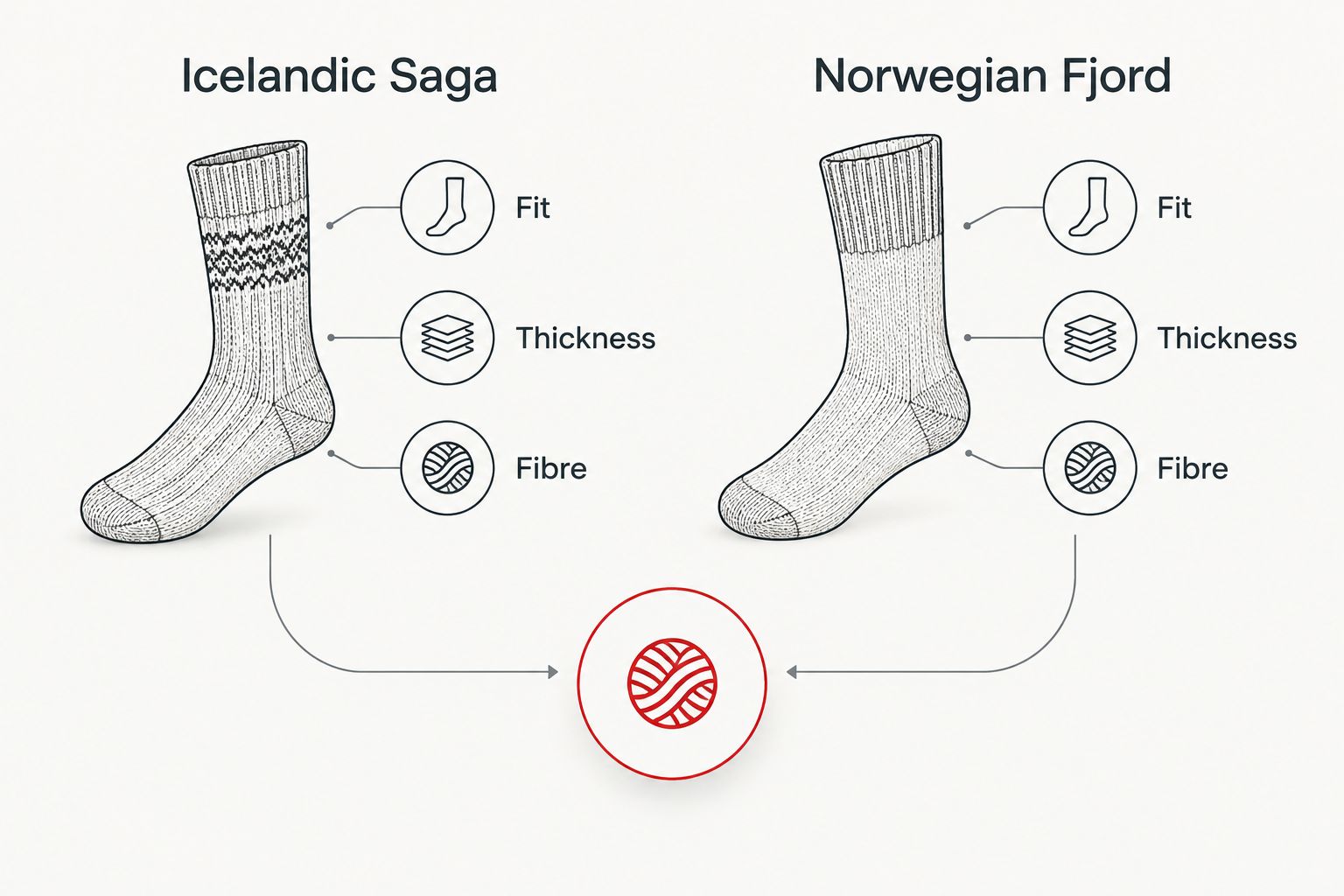
Nordic Sock Company's Icelandic Saga and Norwegian Fjord designs make the naming distinction clear. The available descriptions present both as Nordic-inspired socks; they do not establish that one uses wool from the country in its name or that either is warmer than the other.
| Option | What the supplied description establishes | Best for | Limitation in a warmth comparison |
|---|---|---|---|
| Icelandic Saga Socks – Nordic Red | Icelandic-inspired styling and soft warmth for walks and nights in | You want that design for mixed indoor and outdoor wear | The description gives no measured warmth advantage over Norwegian Fjord Socks |
| Norwegian Fjord Socks | Norwegian-fjord-inspired styling and a soft, strong wool-blend yarn | You want a wool-blend winter sock with the Fjord design | The description gives no measured warmth advantage over Icelandic Saga Socks |
Verdict: choose between these designs by fit and the style you will wear. Do not buy either on the assumption that its name proves which national wool is inside. That rule applies beyond these two pairs in 2026: a place name and a fibre specification answer different questions.
The table compares only what the supplied product descriptions support. It is not a laboratory warmth ranking. To make one, you would need comparable details about the finished socks rather than a judgement based on their names.
Icelandic wool: what its coat tells you
Icelandic sheep are known for a double coat: a finer undercoat and longer, coarser outer fibres. Those fibres offer different characteristics to a textile maker. They do not give every sock described as Icelandic the same feel, thickness or warmth.
For a sock, ask which fibres were used and how the fabric was made. A description of the sheep's coat is not a description of the yarn in your hand. Nor does an Icelandic-inspired pattern establish Icelandic wool content. If provenance matters to you, look for an explicit statement about the wool rather than relying on the product name.
This is also where comfort enters the decision. Coarser fibres can feel less comfortable against some skin than finer fibres, but a finished sock's feel depends on its yarn and construction. Choose based on the actual material details and how the pair feels against your foot, not an expectation that every Icelandic-style sock will feel alike.
Norwegian wool: why the label is broad
Norwegian wool does not identify one sheep breed or one standard sock fabric. Different fibres can be spun and knitted into different kinds of socks. Norwegian wool is not a fixed warmth grade, so it cannot be ranked above or below Icelandic wool as a whole.
The same caution applies to a Norwegian-inspired design. Nordic Sock Company's Norwegian Fjord Socks are described as a soft, strong wool-blend sock inspired by Norway's fjords. That description supports a decision about style and stated yarn type. It does not establish the origin of every fibre or a warmth result against an Icelandic-labelled pair.
In 2026, a useful comparison starts with two specific socks, not two countries. Check their material labels, inspect their thickness and try them with the footwear you intend to use. If those details are absent, the honest answer remains that you cannot tell which will keep your feet warmer.
Why sock warmth varies more than the country name
Use these checks when you compare winter socks in 2026. Each concerns the finished pair you will wear, rather than the scenery or tradition that inspired its design.
- Thickness. A more substantial sock can provide more insulation, provided it still fits comfortably inside your footwear. Thickness alone is not a reason to squeeze a sock into a tight boot.
- Knit. The way yarn is knitted affects the fabric's bulk and feel. Compare the socks themselves rather than assuming that two pairs labelled wool are constructed alike.
- Wool blend. Wool-blend socks contain other fibres as well as wool. Read the fibre label to understand what you are buying; the phrase wool blend does not specify an identical mix across products.
- Footwear fit. Try the sock with the shoes or boots you will actually wear. If your toes feel crowded, choose a less bulky pairing rather than adding thickness at any cost.
- Conditions. A quiet evening indoors and a long winter walk ask different things of a sock. Choose for where your feet will be, not simply for the coldest place named in a product description.
- Dryness. Wet socks are uncomfortable in cold weather. Take wet footwear and socks seriously before trying to solve the problem by choosing a different national wool label.
The practical order is simple: settle the footwear fit, compare the sock fabric, then choose the design. It keeps a 2026 winter-sock purchase grounded in the pair you can wear comfortably.
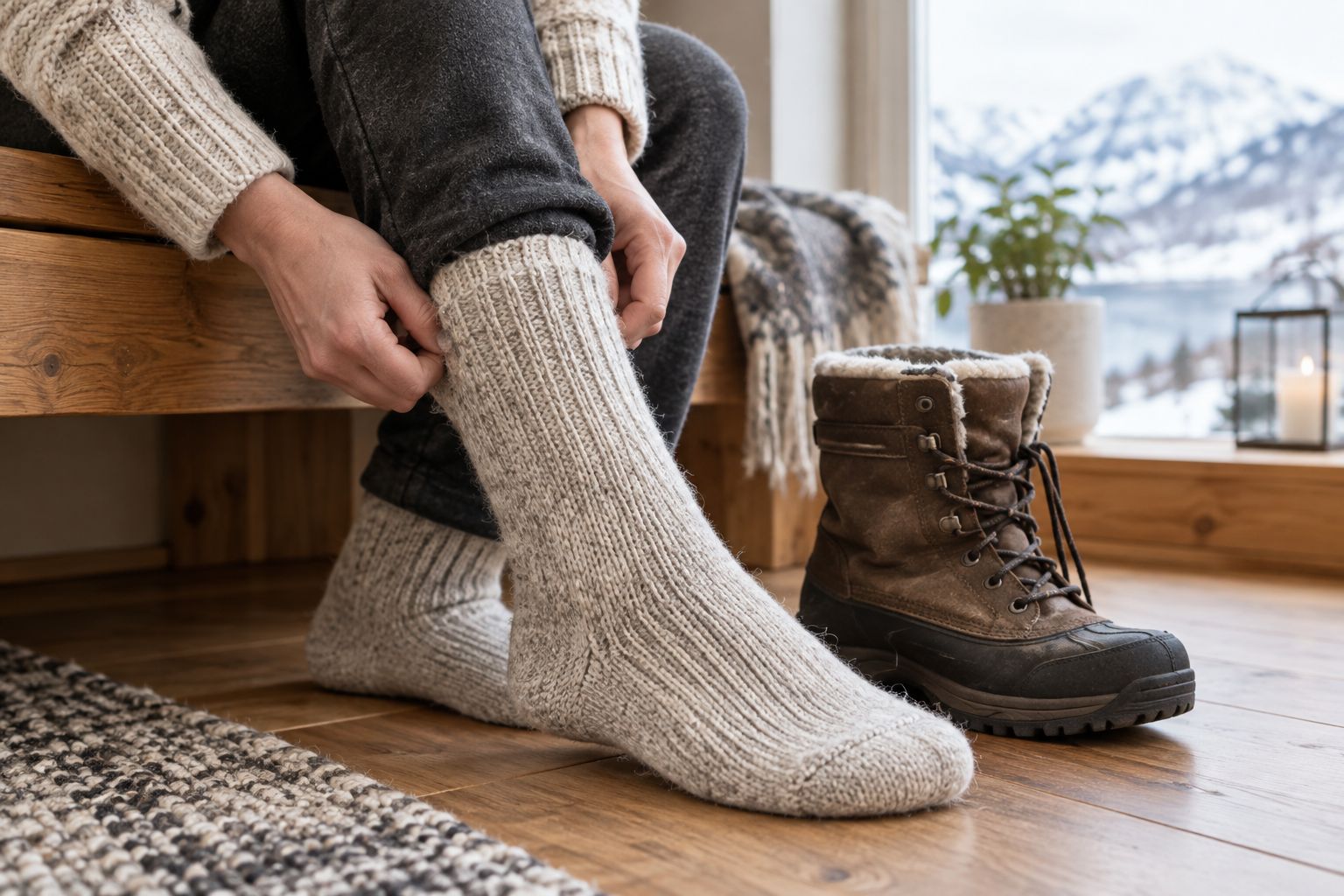
A scene is easier to judge than a fibre name. Imagine the same thick sock in roomy footwear and in a close-fitting boot: the sock has not changed, but your feet have very different room to move. That is why trying a pair with your usual winter footwear tells you something the words Icelandic and Norwegian cannot.
Which Nordic-style socks should you choose?
If your decision is between Icelandic Saga and Norwegian Fjord, start with the designs. Icelandic Saga Socks – Nordic Red are described for outdoor walks and cosy nights in; Norwegian Fjord Socks are described as a soft, strong wool-blend design. Neither supplied description proves that its pair is the warmer one. Pick the style you prefer, then check the current material and fit details for the specific pair.
If you need a sock specifically for winter cold, look for a product description that addresses thickness directly. A named Nordic destination is not a substitute. If your footwear is close-fitting, prioritise a comfortable fit over an extra-bulky sock. If you are buying for indoor wear, the feel against your skin can matter more to you than a claim of maximum thickness.
Nordic Sock Company sells European-made Nordic-style wool-blend winter socks. It is best for shoppers who want that style and a stated wool-blend option, not for anyone trying to identify the warmest national wool from a design name. The honest drawback is that the supplied descriptions do not provide a like-for-like warmth measurement for Icelandic Saga and Norwegian Fjord.
The two designs remain valid choices without declaring a winner. You can favour the Icelandic-inspired look or the Norwegian-fjord-inspired look and still make a sensible warmth decision: check the finished sock. Treat any claim that one country always wins as a prompt to ask for the missing material and construction details.
How should you compare socks before buying?
Compare specific pairs, not country names. This short check works whether you are choosing a Nordic-style wool blend or a sock whose wool origin is explicitly stated.
- Read the fibre label. Check whether the product identifies wool content, other fibres and any stated wool origin. Do not infer origin from a design name.
- Look at the fabric. Compare how substantial the socks are and whether their knit suits the use you have in mind. A description that states thickness is more useful for this question than a reference to Arctic scenery.
- Check the fit with footwear. Make sure your toes have room and the sock stays comfortable when your shoes or boots are on. Judge the combination, not the sock alone.
- Choose for the outing. An indoor evening, a winter walk and time standing outside call for different comfort priorities. Let the setting decide which trade-off matters to you.
Do not turn this into a contest that the product information cannot settle. If two listings lack comparable fibre and construction details, there is no sound basis for calling one warmer. Ask for those details or choose on the qualities the listings do establish.
Product photographs help you judge colour and styling, but they cannot certify fibre origin or measure insulation. The same applies to a heritage-sounding name. In 2026, a clear material description and a comfortable fit are more useful than either when warm feet are the goal.
Can you identify Icelandic wool by the sock's name?
No: a sock's Icelandic name does not verify Icelandic wool. A name can refer to its pattern or inspiration. For fibre provenance, look for an explicit material or origin statement about the wool used in that particular sock.
Are thicker wool socks always warmer in boots?
No: thickness is useful only when the sock and boot fit together comfortably. A bulky sock that crowds your toes is a poor match for that footwear. Check the pair inside your boots rather than choosing thickness in isolation.
Is a wool blend less warm than pure wool?
A wool blend is not automatically less warm than a pure-wool sock. The finished socks can differ in thickness, knit and fit as well as fibre content. Compare the specific pairs; the words wool blend alone do not provide a warmth ranking.
FAQ
Is Icelandic wool warmer than Norwegian wool for socks?
No country-wide warmth ranking establishes Icelandic wool as warmer than Norwegian wool for socks. Compare the finished socks' thickness, knit, fibre content and fit.
Does Icelandic Saga mean the socks contain Icelandic wool?
The Icelandic Saga name does not establish the wool's origin. Check the specific product's material and provenance details rather than inferring fibre origin from its design name.
Are Norwegian Fjord Socks warmer than Icelandic Saga Socks?
The supplied product descriptions do not establish a warmth winner between Norwegian Fjord Socks and Icelandic Saga Socks. Choose by fit and design unless comparable construction details answer your warmth question.
What matters most when choosing warm wool socks for boots?
Start with a comfortable sock-and-boot fit, then compare fabric thickness, knit and fibre content. Extra bulk is a poor choice if it crowds your toes.
Is Norwegian wool one type of wool?
No. Norwegian wool can come from different sheep, so the national label alone does not identify one fibre or a fixed level of warmth.
How can I check whether a sock uses wool from Iceland or Norway?
Look for an explicit statement of wool origin for that sock. A Nordic product name or pattern is not proof of where its wool came from.
One last thing
The most useful question is not which country makes the warmer wool. It is whether the specific sock gives your feet the comfort they need in the footwear you own. In 2026, Nordic Sock Company's Icelandic and Norwegian designs offer different looks, but their names do not settle a warmth contest. Check the finished pair before you choose.