
Is Merino Wool Worth It for Socks? 2026 Verdict
Merino wool is worth it for winter socks if you want warmth that holds up once your feet start sweating, plus less laundry from odor buildup than cotton or acrylic ever manage. The catch: a blend under 60% merino wears through at the heel by midwinter, and pure merino needs a cooler wash cycle than most people give their socks.
- Merino wool is worth it for socks that see real winter use in 2026 — verdict: buy for hiking, commuting and standing outdoors.
- Blend ratio matters more than the word 'merino' on the label: look for 60-80% wool with nylon or elastane worked in.
- 100% merino feels softer but wears out at the heel faster than a reinforced blend under daily boot pressure.
- Cotton and cheap acrylic cost less upfront but lose almost all insulating value once damp with sweat or snowmelt.
- The Ultra Warm Finnish Wool Socks from Nordic Sock Company are the pick for sub-zero mornings; Danish Hygge suits indoor wear, not boots all day.
Why this matters
Socks are the one winter item people buy on autopilot, then complain about all season. Merino wool sits at a higher price point than cotton or acrylic, so the real question isn't whether it's a nice fibre — it's whether the extra cost buys you anything on a cold, wet Tuesday.
It does, but only when the blend is right. A close look at wool percentage benchmarks for winter socks shows the fibre content on the label matters as much as the word "merino" itself — a 30% merino sock and an 80% merino sock are not the same purchase, even at similar weights.
Is merino wool worth it for winter socks?
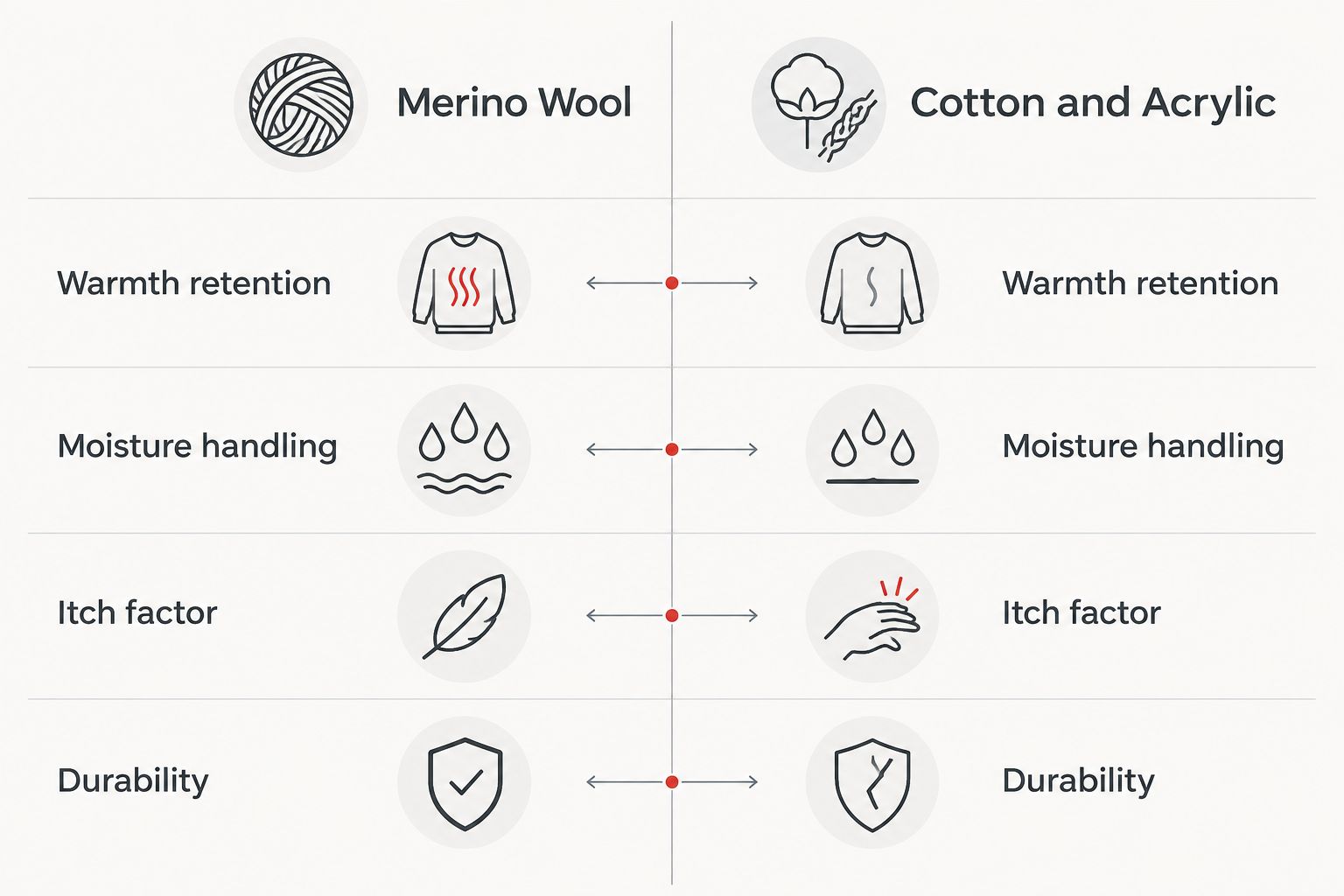
Yes, for anyone spending real time outdoors in winter 2026 — walking the dog, standing at a market stall, hiking, or commuting in the cold. Merino wool keeps insulating even when damp, because the fibre retains its loft with moisture inside it, while cotton collapses and loses most of its warmth the moment it's wet.
| Fibre | Warmth when damp | Moisture handling | Itch factor | Durability | Best for |
|---|---|---|---|---|---|
| Merino wool blend | Holds warmth | Wicks and dries slow | Low (fine grades) | High with nylon reinforcement | Daily winter wear, hiking |
| 100% acrylic/synthetic | Loses warmth fast | Wicks fast, dries quick | None | Moderate, pills over time | Budget everyday socks |
| Cotton | Loses most warmth | Absorbs, stays wet | None | Low in wet conditions | Indoor, dry-weather wear |
| Cashmere-wool blend | Holds warmth | Moderate | Very low | Lower than nylon blends | Lounging, gift socks |
Merino wool blends win on warmth-when-wet and odor control; cotton and acrylic win on upfront cost. That's the trade-off, and it holds whether you're buying one pair or restocking a whole sock drawer for winter 2026.
Why merino wool sock quality varies so much
Not all "merino wool socks" perform the same, even at a similar look and weight. The differences come down to a short list of factors:
- Merino share in the blend — a sock listed at 30% merino behaves closer to a synthetic sock than one at 70-80%.
- Yarn thickness — a thicker gauge traps more warm air but takes up more room inside a boot.
- Heel and toe reinforcement — nylon or elastane worked into the wear points is what keeps a sock alive past one winter.
- Fibre micron count — merino under roughly 19.5-24 microns feels soft against skin; coarser wool grades itch regardless of the word on the label.
- Sock height and coverage — a crew sock leaves ankle skin exposed to cold air that a knee-high style covers.
- Finishing and knit density — a tightly knit sock traps more warm air than a loosely knit one of the same weight.
Is 100% merino wool better than a wool blend?
100% merino wool is not automatically better than a blend — it feels softer against the skin but breaks down at the heel and toe faster once nylon or elastane isn't there to take the friction. Most winter sock makers, Nordic Sock Company included, blend merino with a smaller share of synthetic fibre specifically to extend the life of the sock under daily boot pressure. Checking how to spot genuine merino wool versus a synthetic blend before buying avoids paying merino prices for a sock that's mostly filler fibre.
How long do merino wool socks last compared to cotton?
A well-blended merino sock with reinforced heels typically outlasts a cotton sock by a full season or more of regular winter wear, because cotton fibres break down faster once they've been repeatedly soaked and dried. Cotton also loses shape at the ankle cuff sooner, since it has none of wool's natural elasticity.
Is merino wool itchy?
Fine merino wool, the grade used in most quality winter socks, runs under roughly 24 microns in fibre diameter, which is fine enough that most wearers don't find it scratchy the way coarser wool can feel. Itch complaints about "wool socks" almost always trace back to a coarse, low-grade wool blend rather than genuine fine merino.
Which merino wool sock should you buy in 2026?
Once the blend is right, the decision comes down to what you're using the socks for. Here's how three styles stack up for winter 2026:
- Ultra Warm Finnish Wool Socks (Black) — thick wool-blend yarn built for the worst of the cold. Best for sub-zero mornings, long days outdoors and standing jobs. Buy if you need maximum warmth.
- Danish Hygge Socks — soft wool blend suited to fireside evenings and shorter outdoor walks rather than a full day in boots. Best for indoor lounging and cold nights in. Buy for cosy wear, skip for a full day on your feet outdoors.
- Swedish Lagom Socks — a lighter, pillowy wool blend for everyday wear rather than extreme cold. Best for daily commuting and office wear. Buy for everyday warmth without bulk.


FAQ
Is merino wool worth it for socks in 2026?
Yes, merino wool is worth it for socks that see real winter use — it insulates when damp and resists odor in a way cotton and most acrylic blends can't match. Skip it only if you need socks purely for short indoor wear, where a cheaper acrylic blend does the same job.
Do merino wool socks work for sweaty feet?
Merino wool handles sweaty feet better than cotton because the fibre wicks moisture away from skin and doesn't hold onto odor the way synthetic fibres do. It won't feel bone-dry the way a synthetic wicking sock does, but it won't smell after a long day either.
Can you wear merino wool socks in trainers, not just boots?
Yes, a lighter merino blend works fine in trainers, though the thicker styles built for extreme cold are cut for boot room, not a snug trainer fit. Check the sock's weight and height before pairing it with anything other than winter boots.
How do you tell genuine merino wool from a synthetic blend?
Genuine merino wool feels soft rather than slick to the touch and the label lists a wool percentage, usually 60-80% in a quality winter sock, rather than just the word 'wool-look' or 'wool-style.' A sock with no fibre percentage listed is usually mostly synthetic.
Do merino wool socks need special washing?
Merino wool socks need a cooler wash cycle than cotton tolerates, since heat and tumble drying can shrink or felt the fibre. A cool machine wash and flat drying keep the sock's size and shape intact through a full winter.
Are cheaper wool-blend socks any good, or is 100% merino always better?
A well-made blend with 60-80% merino and nylon reinforcement often outlasts 100% merino at the heel and toe, so cheaper isn't automatically worse. What matters is the wool share and where the reinforcement sits, not the word 'merino' alone.
Is merino wool warmer than acrylic thermal socks?
Merino wool stays warmer than acrylic once feet start sweating, because acrylic loses insulating value quickly when damp while merino keeps its loft. In dry conditions the two perform closer to each other.
How many pairs of merino wool socks do you need for winter?
Most people get through winter comfortably with 3-5 pairs in rotation, since merino's odor resistance means each pair can go longer between washes than a cotton or acrylic sock. More pairs simply mean less frequent washing, not better warmth.
One last thing
There is no such thing as bad weather, only bad socks. The Nordic saying holds up on the numbers: a merino wool blend at 60-80% wool with reinforced heels will outperform a cheap synthetic sock in every winter condition that matters, from a wet dog walk to a full shift on your feet. The one place people go wrong isn't the fibre — it's buying on the word "merino" alone without checking the blend percentage behind it. Read the label before the price tag.