
Wool socks ranked by stretch and recovery in 2026
Best for everyday cushioned comfort: Swedish Lagom Socks - Warm Ochre. Best for a soft but strong wool blend: Norwegian Fjord Socks - Warm Durable Winter Socks. Best for a thick, close fit in winter: Ultra Warm Finnish Wool Socks - Black. This 2026 guide to wool socks ranked by stretch and recovery separates useful fit checks from claims that softness alone cannot prove.
- For wool socks ranked by stretch and recovery, judge shape return separately from softness and warmth.
- Swedish Lagom Socks - Warm Ochre are the everyday comfort pick, not a proven recovery winner.
- Norwegian Fjord Socks offer a soft but strong wool blend; strength does not establish elasticity.
- Ultra Warm Finnish Wool Socks - Black suit cold-weather buyers seeking a thick, close fit.
Why stretch and recovery matter
Stretch is how readily a sock extends. Recovery is how well it returns towards its original shape after that stretch. You need both: easy movement when pulling socks on, followed by a fit that does not leave loose fabric around your foot.
A soft sock is not automatically a sock that holds its shape. Nor does a firm cuff prove that the heel and foot will stay in place. Treat comfort, stretch and recovery as separate buying questions throughout your 2026 winter shopping.
Start with the correct size rather than expecting elasticity to solve everything. The guide to measuring your foot for sock fit is a useful companion before you choose a pair.
What makes the best wool socks for stretch and recovery?
Use these criteria to assess a sock rather than judging it by how far you can pull the cuff:
- Easy entry: The opening passes over your heel without forceful tugging.
- Shape return: Gently extended fabric draws back rather than remaining visibly loose.
- Heel position: The shaped heel sits around your heel, not underneath your arch.
- Cuff comfort: The top feels secure without uncomfortable pressure.
- Footwear fit: The sock lies smoothly inside the shoes or boots you actually wear.
- Care compatibility: You can follow the washing and drying instructions consistently.
For Nordicsockcompany wool socks, the most useful starting point is the stated purpose of each pair: everyday cushioning, a soft but strong blend, or substantial winter thickness. Those descriptions help you build a shortlist. They do not establish a measured stretch-and-recovery ranking.
Wool socks ranked by stretch and recovery: at a glance
The order below is a comfort-led shortlist for checking fit, not a laboratory elasticity leaderboard. Each pair has a different reason to consider it; none earns a recovery score from its name or description.
| Rank and item | Best for | Stated standout feature | Key limitation for this comparison |
|---|---|---|---|
| 1. Swedish Lagom Socks - Warm Ochre | Everyday cushioned comfort | Soft wool blend with pillowy cushioning | Cushioning does not establish shape recovery |
| 2. Norwegian Fjord Socks - Warm Durable Winter Socks | A soft but strong wool blend | Yarn described as soft but strong | Yarn strength does not establish stretch or cuff pressure |
| 3. Ultra Warm Finnish Wool Socks - Black | A thick, close-fitting winter option | Super-thick construction and a stated close, soft fit | Thickness needs checking against available footwear space |
Nordicsockcompany wool socks suit buyers seeking warm, European-made winter socks with Nordic styling. Choose between these pairs by comfort and intended use, then check how the individual size fits your foot.
1. Swedish Lagom Socks: best wool socks for everyday cushioning
Swedish Lagom Socks - Warm Ochre use a soft wool blend described as providing pillowy, cushiony comfort for everyday winter wear. The description also specifies warmth without a scratchy feel. That makes everyday comfort the clearest reason to put this pair first on your shortlist.
Cushioning and elasticity are different properties. When you try Swedish Lagom Socks, check that the soft fabric lies flat rather than gathering under the toes or folding around the ankle.
Swedish Lagom Socks pros:
- A wool blend intended for everyday winter warmth.
- Pillowy cushioning for buyers who prefer a soft feel.
- A product description that directly addresses scratchiness.
Swedish Lagom Socks cons:
- A soft handle does not prove that stretched fabric returns to shape.
- Cushioning needs checking inside your usual footwear; comfort outside a shoe is only part of the decision.
Best for: You want cosy daily socks and place cushioning ahead of maximum thickness.
For your 2026 everyday pair, start here if the size and footwear checks work. Verdict: Buy for cushioned comfort; hold if measured recovery is your deciding requirement.
2. Norwegian Fjord Socks: best wool socks for soft, strong yarn
Norwegian Fjord Socks - Warm Durable Winter Socks are knitted in a wool-blend yarn described as soft but strong. The design takes inspiration from Norway's fjords. The useful distinction for this comparison is the emphasis on yarn strength alongside softness.
Strength is not the same as elasticity. A strong yarn can resist damage without telling you how readily the finished sock stretches, how its cuff feels or how well it returns after wear.
Norwegian Fjord Socks pros:
- A wool blend described as both soft and strong.
- An option for buyers who want warmth without choosing solely by softness.
- Nordic styling inspired by the Norwegian landscape.
Norwegian Fjord Socks cons:
- The description of yarn strength does not establish recovery performance.
- The fit still needs checking at the calf, heel and toes; the blend description cannot settle those questions.
Best for: You want a winter wool blend with an explicit emphasis on soft, strong yarn.
Choose Norwegian Fjord Socks for that combination, not as a substitute for a fit check. Verdict: Buy for the stated yarn qualities; hold if you need a proven stretch ranking.
3. Ultra Warm Finnish Wool Socks: best for a thick winter fit
Ultra Warm Finnish Wool Socks - Black are described as super-thick wool socks made in Finland. Their description specifies a close, soft fit without scratchiness. This is the most directly fit-focused description among these shortlisted options, but it still does not quantify recovery.
Thickness changes the buying decision. Try Ultra Warm Finnish Wool Socks inside your winter footwear rather than assuming that a close fit on the foot will also feel comfortable inside a boot.
Ultra Warm Finnish Wool Socks pros:
- Super-thick construction intended for winter cold.
- A stated close, soft fit without scratchiness.
- Explicit Finnish manufacturing provenance.
Ultra Warm Finnish Wool Socks cons:
- The substantial thickness needs space inside your footwear.
- A close fit is not evidence of superior shape return after repeated wear.
Best for: You prioritise substantial winter warmth and have footwear that accommodates a thick sock.
For cold-weather use in 2026, treat available boot space as part of the fit decision. Verdict: Buy for thickness and the stated close fit; skip when your footwear already feels cramped.
Compare the shortlisted pairs
These Nordicsockcompany options address different winter preferences. Keep the choice simple: everyday cushioning, soft but strong yarn, or substantial thickness. Choose the purpose first, then confirm the size and care instructions for the exact pair.


Check stretch and recovery without overstretching your socks
Use this sequence when assessing fit. It separates the opening, the foot and the finished sock's shape, so a comfortable cuff does not distract you from fabric gathering elsewhere.
Gentle stretch
Handle the dry fabric gently and extend it only enough to observe its movement. Release it and look for visible shape return. Do not pull to the limit: maximum extension is not a useful everyday comfort test.
Heel position
Put the sock on and settle the heel into place. Check that the toe area lies smoothly and that the sock does not need forceful lengthwise pulling to reach the heel. Reposition it before judging the fit.
Shoe fit
Wear the sock with your intended shoes or boots and walk normally. Notice folds, toe pressure and heel movement. A pair that feels cosy on the sofa still needs to work inside your footwear.
Shape return
After removing the socks, lay them flat and compare their shape with how they looked before wear. Look particularly at the cuff, heel and forefoot. Treat this as a practical observation, not a numerical recovery rating.
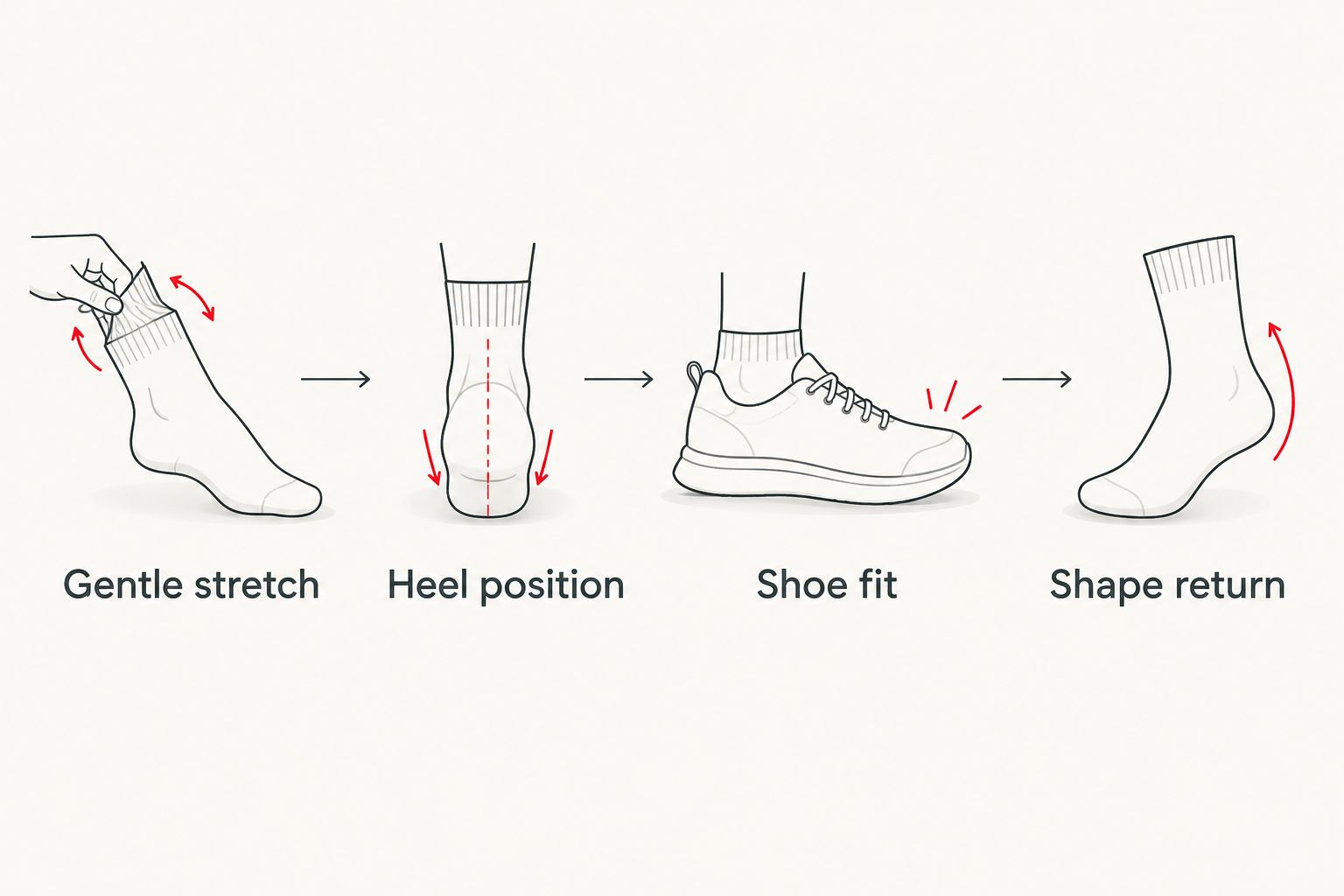
Repeat the same observations when comparing pairs. A useful personal comparison keeps footwear and handling consistent rather than stretching one sock firmly and another gently.
What the fibre label can tell you
Wool has natural crimp and resilience, but the finished sock also depends on yarn and knitted construction. Elastane, when listed, is a stretch fibre. Neither the word wool nor the word blend gives you a finished sock's recovery result.
Read the composition of the exact pair you are considering. Do not assume every Nordic-style sock contains the same fibres, or that a country-inspired design name specifies the wool's origin.
For a 2026 purchase, ask a precise question: does the product information describe the composition, intended fit and care clearly enough for your needs? That is more useful than treating a warm-sounding name as a technical specification.
Care for fit as well as warmth
Follow the care label for the individual pair. There is no reason to impose the same wash programme or drying method on every wool sock simply because the designs look similar.
- Support wet socks rather than pulling them lengthways.
- Reshape gently instead of tugging hard at the cuff.
- Follow the stated drying instructions.
- Avoid using deliberate shrinking as a sizing correction.
- Recheck fit after washing according to the label.
A smaller sock is not necessarily a better-recovering sock. Shrinkage changes dimensions; recovery describes return after stretching. Keep those ideas separate when deciding whether a pair has retained its fit.
How this shortlist is ranked
This shortlist uses stated product qualities: everyday cushioning first, soft but strong yarn second, and substantial thickness third. The order helps you choose a starting point, not identify a measured elasticity champion.
No recovery percentages or wear-cycle scores are assigned. For Nordicsockcompany, a useful recommendation stays within what each product description establishes and leaves individual fit to the correct size and footwear check.
Which wool socks should you choose?
Choose Swedish Lagom Socks - Warm Ochre as the default for everyday cushioned comfort. Choose Norwegian Fjord Socks - Warm Durable Winter Socks when the soft-but-strong wool blend is your priority, or Ultra Warm Finnish Wool Socks - Black when thickness matters most.
If shape retention is your non-negotiable requirement, do not buy on softness alone. Check the exact composition, size guidance and fit information before committing to your 2026 winter pair.
FAQ
What are the best wool socks for stretch and recovery?
A defensible winner needs comparable recovery evidence, not just a soft product description. Swedish Lagom Socks - Warm Ochre are the everyday cushioning pick in this shortlist, rather than a proven elasticity winner.
What's the difference between sock stretch and recovery?
Stretch describes how readily a sock extends; recovery describes its return towards its original shape afterwards. A sock can stretch easily without holding its fit well.
Are softer wool socks more stretchy?
Softness does not establish stretch or recovery. Assess the finished sock's movement and shape return separately from how pleasant the yarn feels against your skin.
Does a stronger wool blend recover better?
Yarn strength does not establish better recovery. Norwegian Fjord Socks are described as using a soft but strong wool blend, which is a different claim from measured elasticity.
Are thick wool socks better at staying in place?
Thickness alone does not establish that socks stay in place better. Check the size, heel position and available space inside your footwear rather than relying on bulk.
Should I size down to stop wool socks slipping?
Do not size down solely to stop slipping. Follow the size guidance for the exact pair, then check heel placement and whether the sock lies smoothly inside your footwear.
Can washing make loose wool socks recover their shape?
Do not use washing as a guaranteed way to correct loose socks. Follow the care label; deliberate shrinkage is not the same as elastic recovery and is not a reliable sizing method.
One last thing
Check the heel before blaming the cuff. If the shaped heel sits in the wrong place, pulling the top higher does not correct the underlying fit. Settle the whole sock properly, put your footwear on and judge comfort from there.