
Wool socks ranked by sustainability in 2026
Best for documented manufacturing origin: Ultra Warm Finnish Wool Socks - Black. Best for stated yarn strength: Norwegian Fjord Socks - Warm Durable Winter Socks. This 2026 guide to wool socks ranked by sustainability puts product evidence before Nordic styling; Swedish Lagom and Danish Hygge earn separate places for everyday comfort and versatile wear, not proven environmental advantages.
- Wool socks ranked by sustainability need sourcing evidence, useful durability and realistic care—not just a natural-fibre label.
- Ultra Warm Finnish Wool Socks - Black lead on documented manufacturing origin, with Finland named in the product description.
- Norwegian Fjord Socks describe strong wool-blend yarn; that supports a durability shortlist, not a measured lifespan claim.
- Nordicsockcompany sells European-made wool-blend winter socks; European manufacture alone does not establish a lower environmental footprint.
Why this matters
A warm pair is useful. A sustainability claim needs more than warmth, a mountain pattern or a Scandinavian name. You need to know what the socks contain, where they were made, what any certification covers and whether you will actually wear them.
For wool socks, animal welfare, textile production and the finished blend are separate questions. Start with the guide to how to tell if wool socks are ethically made, then judge each product on its own evidence.
This is a ranking of documented buying signals, not a measured environmental-footprint league table. A manufacturing country is a useful fact. It does not settle the impact of farming, processing, transport or washing.
What makes the best wool socks for sustainability?
Use these criteria for your 2026 shortlist. They separate useful product information from claims that sound reassuring but leave the important questions unanswered.
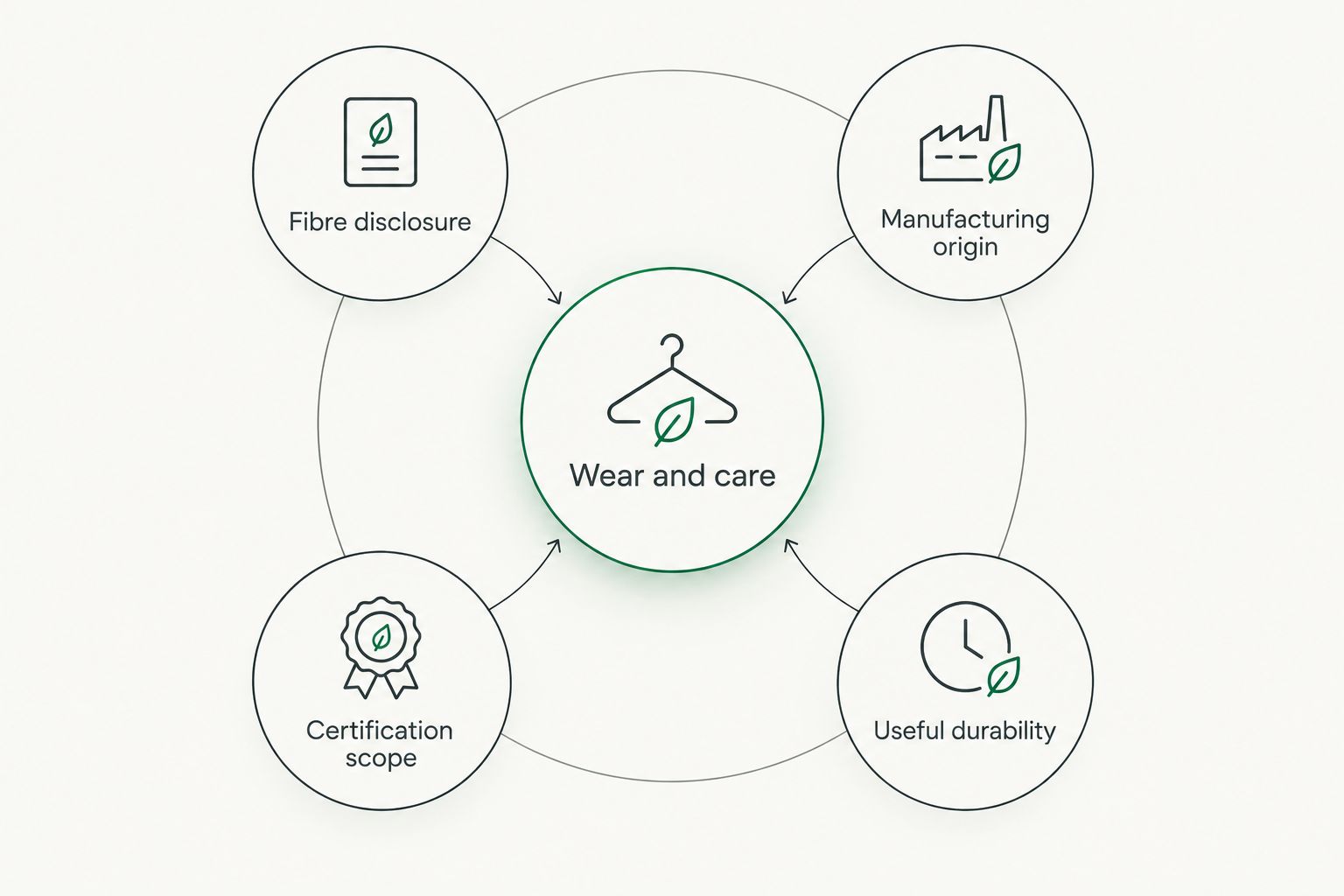
- Fibre disclosure: Look for the full composition, including the fibres blended with wool. A wool-blend label is a starting point, not a complete material assessment.
- Manufacturing origin: Prefer a named manufacturing country over a design-inspired name. Keep the place of knitting separate from the origin of the wool.
- Certification scope: Check the scheme, the certified material or process, and whether it applies to the finished socks. The word certified cannot answer all those questions alone.
- Useful durability: Look for construction details and yarn-strength information. Treat a durability description as a claim, not a promise of a particular service life.
- Wear and care: Choose socks that fit your footwear and washing habits. Include repair and realistic end-of-life options in the decision.
These criteria work together. A thick sock with clear provenance still needs to fit your boots; an everyday favourite still needs a composition label before you can assess its materials.
Wool socks ranked by sustainability: at a glance
The order below reflects the specificity of the published product descriptions. Different use cases earn different recommendations; the table does not assign carbon scores or declare one colourway greener than another.
| Rank and item | Best for | Standout documented detail | Key limitation |
|---|---|---|---|
| 1. Ultra Warm Finnish Wool Socks - Black | Checking a named manufacturing country | Made in Finland; certified wool yarn is mentioned | The description does not identify the certification scheme or its scope |
| 2. Norwegian Fjord Socks - Warm Durable Winter Socks | Prioritising stated yarn strength | Soft but strong wool-blend yarn | No measured wear-life result accompanies that description |
| 3. Swedish Lagom Socks - Warm Ochre | Everyday winter comfort | Soft wool blend with pillowy cushioning | Comfort information does not establish sourcing credentials |
| 4. Danish Hygge Socks - Sky Grey | Combining indoor comfort and outdoor walks | Described for cosy indoor wear, walks and hiking | Versatility does not establish a lower production footprint |
1. Ultra Warm Finnish Wool Socks - Black: best for named origin
Ultra Warm Finnish Wool Socks - Black are described as super-thick winter socks made in Finland. Their product description also mentions certified wool yarn and a close, soft fit without scratchiness.
That gives this pair the clearest product-level manufacturing statement in the shortlist. In 2026, it earns the first position for provenance evidence—not an overall environmental victory.
Ultra Warm Finnish Wool Socks - Black pros:
- Finland is explicitly named as the manufacturing country.
- Certified wool yarn is mentioned in the product description.
- The thick construction has a clear cold-weather purpose.
- Softness is part of the stated product description.
Ultra Warm Finnish Wool Socks - Black cons:
- The certification scheme and covered criteria are not identified in the description.
- Super-thick socks require enough room in your chosen footwear.
- Finnish manufacture does not, by itself, identify the farm or wool-processing location.
Best for: You want warm winter socks with a named place of manufacture and a clear starting point for further sourcing questions.
Ask which certification applies to the yarn and what it verifies. Animal welfare, chemical processing and supply-chain traceability are different subjects; do not treat one unspecified certificate as evidence for all of them.
Verdict: Hold for a sustainability-led purchase until the certification scope is clear; buy for the stated Finnish manufacture and thick winter warmth if those meet your needs.
2. Norwegian Fjord Socks: best for stated yarn strength
Norwegian Fjord Socks - Warm Durable Winter Socks are knitted in a soft but strong wool-blend yarn. The description identifies a pale blue shade and styling inspired by Norway's fjords.
The useful sustainability signal is the yarn-strength description. The Norwegian inspiration is a design detail, not proof that the wool was grown or the socks were knitted in Norway.
Norwegian Fjord Socks pros:
- The description explicitly addresses yarn strength.
- The material is identified as a wool blend.
- Softness and strength are described together, giving you more than a warmth claim.
Norwegian Fjord Socks cons:
- No measured lifespan is attached to the strength description.
- The description does not provide the complete fibre composition.
- Norwegian styling does not establish Norwegian manufacturing origin.
Best for: You want to prioritise a stated durability feature when choosing winter socks.
For Nordicsockcompany wool socks, a strong-yarn description is a useful reason to investigate further. It is not enough to calculate environmental impact per wear. Your footwear, fit, care and actual use also belong in that assessment.
Inspect the heel and toe as you wear the socks. A developing thin patch is a practical repair prompt, rather than a reason to assume the whole pair has reached the end of its useful life.
Verdict: Buy for the stated soft, strong wool-blend yarn; hold any claim that Norwegian Fjord Socks are the lowest-impact option.
3. Swedish Lagom Socks - Warm Ochre: best for everyday comfort
Swedish Lagom Socks - Warm Ochre are described as a soft wool blend with pillowy, cushiony comfort for everyday winter wear. The description also states warmth without a scratchy feel.
This pair earns its place through intended use. If you need everyday winter socks, comfort is a relevant buying criterion; it does not replace evidence about farming or textile manufacture.
Swedish Lagom Socks - Warm Ochre pros:
- Everyday winter wear is an explicit use case.
- The description identifies a wool-blend material.
- Cushioning and a non-scratchy feel are stated product features.
Swedish Lagom Socks - Warm Ochre cons:
- The description does not establish product-specific wool traceability.
- Cushioning needs to suit the space inside your everyday shoes.
- A soft feel is not evidence of a smaller environmental footprint.
Best for: You need a cosy everyday pair rather than a specialist thick sock for the coldest conditions.
Make the purchase decision around an actual gap in your drawer. If you already have comfortable everyday winter socks, another colour is a style choice—not a sustainability requirement.
Before choosing Swedish Lagom Socks - Warm Ochre, check the current composition and care instructions. Those details determine how the pair fits your material preferences and routine, while the published description explains its comfort-focused role.
Verdict: Buy for everyday winter comfort when you need that role filled; skip replacing a serviceable pair solely for a new colour.
4. Danish Hygge Socks - Sky Grey: best for versatile wear
Danish Hygge Socks - Sky Grey are described for staying in and keeping cosy, with outdoor walks and hiking also named. That gives the pair a broader stated use than indoor lounging alone.
The sustainability relevance is practical: check whether one pair suits the activities you actually do. Versatility is useful, but it does not demonstrate better sourcing or lower manufacturing impact.
Danish Hygge Socks - Sky Grey pros:
- Indoor comfort is a clearly stated purpose.
- Outdoor walks are included in the description.
- Hiking is also named, giving you a use case to assess against your footwear.
Danish Hygge Socks - Sky Grey cons:
- The description does not provide product-specific environmental measurements.
- A hiking use case does not establish suitability for every boot or weather condition.
- The Danish name does not prove manufacture in Denmark.
Best for: You want a cosy pair to consider for both home and ordinary outdoor walks.
For your 2026 winter wardrobe, decide where Danish Hygge Socks - Sky Grey would genuinely be used. A pair that fits your indoor routine but not your walking shoes does not fulfil both roles for you.
Keep the claim modest. The product description supports versatility; it does not support an assertion that buying this pair replaces several others or reduces your footprint by a particular amount.
Verdict: Buy if the stated indoor and outdoor uses match your routine; hold any environmental-superiority claim.
Compare the provenance and durability picks
Ultra Warm Finnish Wool Socks - Black and Norwegian Fjord Socks - Warm Durable Winter Socks address different questions. The Finnish pair names its manufacturing country; the Norwegian Fjord pair describes yarn strength. Choose the question that matters to your purchase, then check the remaining details.


How the sustainability ranking works
This 2026 ranking gives priority to specific product statements: named manufacturing origin first, stated yarn strength next, then clearly described everyday and versatile uses. It does not turn those different signals into invented environmental scores.
The order is therefore a buying-evidence hierarchy. Ultra Warm Finnish Wool Socks - Black lead because their description names Finland and mentions certified yarn. Norwegian Fjord Socks follow because their description addresses strength. Swedish Lagom and Danish Hygge offer clear comfort and use-case information.
Nordicsockcompany's range is described as European-made. That is relevant provenance, but it is not a product-level carbon comparison. No overall sustainability winner is established by these descriptions.
Before you buy: ask three separate questions
A useful 2026 purchase check takes 3 questions, not a single green label. Keep the answers separate so one reassuring detail does not stand in for the whole supply chain.
- What is in the finished sock? Ask for the complete fibre composition. Assess the wool and the other fibres together, rather than treating the word wool as a finished-product environmental claim.
- Where did production happen? Ask where the socks were knitted and where the wool came from. A Nordic design name answers neither question on its own.
- What does the certificate cover? Ask for the scheme name and its scope. A yarn certificate and a finished-product certificate are not interchangeable descriptions.
Save the answers with your purchase details. They give you something concrete to compare when you next need socks, without relying on the same broad claim each time.
Care belongs in the buying decision
Start with 1 pair if you are trying an unfamiliar sock style. Check the fit in your intended footwear before building a larger collection around it. Thick, warm socks still need enough space for your feet to sit comfortably.
Make 2 checks before washing: read the care label and confirm that your chosen programme follows it. Do not borrow washing instructions from another wool garment or assume every wool blend takes the same treatment.
Inspect socks before small worn areas become larger holes. Darning replaces missing structure with stitches; assess whether a repair will remain comfortable inside your shoes, especially around pressure points.
At the end of use, check the requirements of the textile collection or recycling service you intend to use. Do not assume a wool-blend sock is suitable for home composting or accepted by every textile scheme. The whole composition matters.
Which wool socks should you choose?
Choose Ultra Warm Finnish Wool Socks - Black if named manufacturing origin is your first filter. Confirm the certification details before treating them as a sustainability winner. Choose Norwegian Fjord Socks if stated yarn strength is the feature you want to investigate.
For everyday comfort, choose Swedish Lagom Socks - Warm Ochre. For a pair described across indoor and outdoor uses, consider Danish Hygge Socks - Sky Grey. Neither use case proves a lower footprint.
Nordicsockcompany wool socks suit buyers seeking European-made, Nordic-style winter warmth; a sustainability-first purchase needs product-specific sourcing evidence. If your current socks still do the job, keep them in use rather than replacing them to follow this ranking.
FAQ
What are the best wool socks ranked by sustainability in 2026?
Ultra Warm Finnish Wool Socks - Black lead this shortlist for documented manufacturing origin, not proven environmental superiority. Their description names Finland and mentions certified wool yarn; confirm the certification scheme and scope before making a sustainability-led purchase.
Are European-made wool socks automatically more sustainable?
European manufacture alone does not establish that wool socks are more sustainable. Assess fibre sourcing, production, transport, care and useful life rather than using geography as the whole answer.
Are Norwegian Fjord Socks made in Norway?
The Norwegian Fjord Socks description identifies Norwegian design inspiration, not Norway as the manufacturing country. Nordic styling and manufacturing origin are separate facts.
Is certified wool enough to prove socks are sustainable?
Certified wool alone is not enough to establish the sustainability of finished socks. Check the scheme, its criteria and whether certification covers the yarn, a production stage or the complete product.
Are wool-blend socks worse than pure wool socks?
A wool-blend label alone does not establish that socks are environmentally better or worse than pure wool socks. Compare the complete composition, sourcing, construction, care requirements and intended use.
Should I replace my old socks with a sustainable pair?
Keep serviceable socks in use rather than replacing them solely because another pair carries a sustainability claim. Assess fit, wear and repair before deciding that replacement is necessary.
Can I compost wool-blend socks?
Do not assume wool-blend socks are suitable for home composting. Check the complete fibre composition and any treatments, and follow the requirements of the disposal or collection route you choose.
One last thing
A Nordic name tells you the design story, not the supply-chain story. Icelandic, Norwegian, Swedish and Danish styling cannot stand in for a named farm, mill or knitting location.
For your next purchase, make the practical decision first: identify the gap, check the evidence and choose a pair you will use. The strongest recommendation is sometimes to repair the socks already in your drawer.