
Do Old Wool Socks Lose Warmth Over Time? 2026 Verdict
Old wool socks do lose warmth over time, but the sock rarely goes cold entirely on its own — hot washes, tumble drying and daily friction against a boot lining do most of the real damage. Here's what's actually happening inside the fibre, how to spot the point where a pair has genuinely lost its warmth, and when it's actually time to reach for a fresh pair rather than keep patching one up.
- Wool socks lose warmth mainly through felting and pilling, not simple age on the shelf.
- Felted, matted wool traps less air, and trapped air is what keeps feet warm.
- A shiny, thin heel is the clearest sign a wool sock has already lost most of its warmth.
- Washing at 30°C and air-drying flat keeps wool socks warm for several winters, not just one.
- Nordic Sock Company's Ultra Warm Finnish Wool Socks use a denser knit that holds its loft longer under daily wear.
Why this matters
Cold feet on a January morning get blamed on "old socks" more often than they get blamed on the washing machine, and that's backwards for most wool socks. Wool fibre doesn't have a shelf life the way food does — it degrades through what happens to it, not through years spent folded in a drawer. That's true whether the socks are a supermarket multipack or a wool-blend pair from Nordic Sock Company.
That distinction changes what you actually do about a pair that feels thinner than it used to. If warmth has genuinely dropped, the fix is sometimes a different wash routine rather than a fresh order. Check how long wool socks last before assuming a favourite pair is finished — a lot of socks written off as "worn out" have simply been through one hot wash too many.
There's an old Scandinavian saying that there's no such thing as bad weather, only bad socks — and by 2026 that logic still holds for wool care too. Bad washing habits do more to end a sock's warm life than a decade of correct ones ever would.
Do old wool socks lose warmth over time?
Yes — but how much warmth a wool sock loses depends on what's happened to it, not on how many winters it's technically been owned. Wool keeps feet warm by trapping still air inside a network of crimped fibres; anything that flattens, mats or thins that structure shrinks the air pocket and the warmth along with it.
| Sock condition | What's happening to the fibre | Warmth retention | Best for |
|---|---|---|---|
| New, unworn | Full crimp, fibres springy and separated | High | Coldest days, first wear of the season |
| Lightly worn, hand-washed and air-dried | Crimp slightly compressed, still lofted | Medium-high | Everyday winter wear |
| Heavily worn, machine-dried on heat | Fibres flattened and matted (felted) | Low | Indoor lounging only |
| Thin, shiny patches at heel or toe | Yarn abraded away, little left to trap air | Very low | Retirement — darn or replace |
The drop from "medium-high" to "low" rarely happens gradually while a sock just sits on a shelf. It happens fast, over a handful of hot washes or a session too many in a tumble dryer — which is why two pairs bought the same winter can end up in completely different rows of that table, including Nordic Sock Company's own ranges. The mechanism doesn't change by brand, only by care.
How wool loses its warmth
Wool fibre is naturally crimped: it curls slightly along its length, and that curl is what creates tiny pockets of trapped air once the yarn is knitted into a sock. Air is the actual insulator here — wool fibre is just the scaffolding holding it in place close to your skin.
Two things break that scaffolding down. Felting happens when heat, moisture and agitation combine — a hot wash, a hard spin cycle, a tumble dryer — and the microscopic scales on each wool fibre lock together permanently. Once felted, the fibres can't spring back into their crimped shape, so the sock traps noticeably less air even though it still looks like a normal sock from the outside.
Abrasion is a separate, simpler process. The heel and toe of any sock rub against the inside of a boot or shoe with every single step, and that friction wears the yarn thin regardless of how carefully the socks are washed. A thin patch simply has less material left to trap air in, no matter how warm the wool started out.
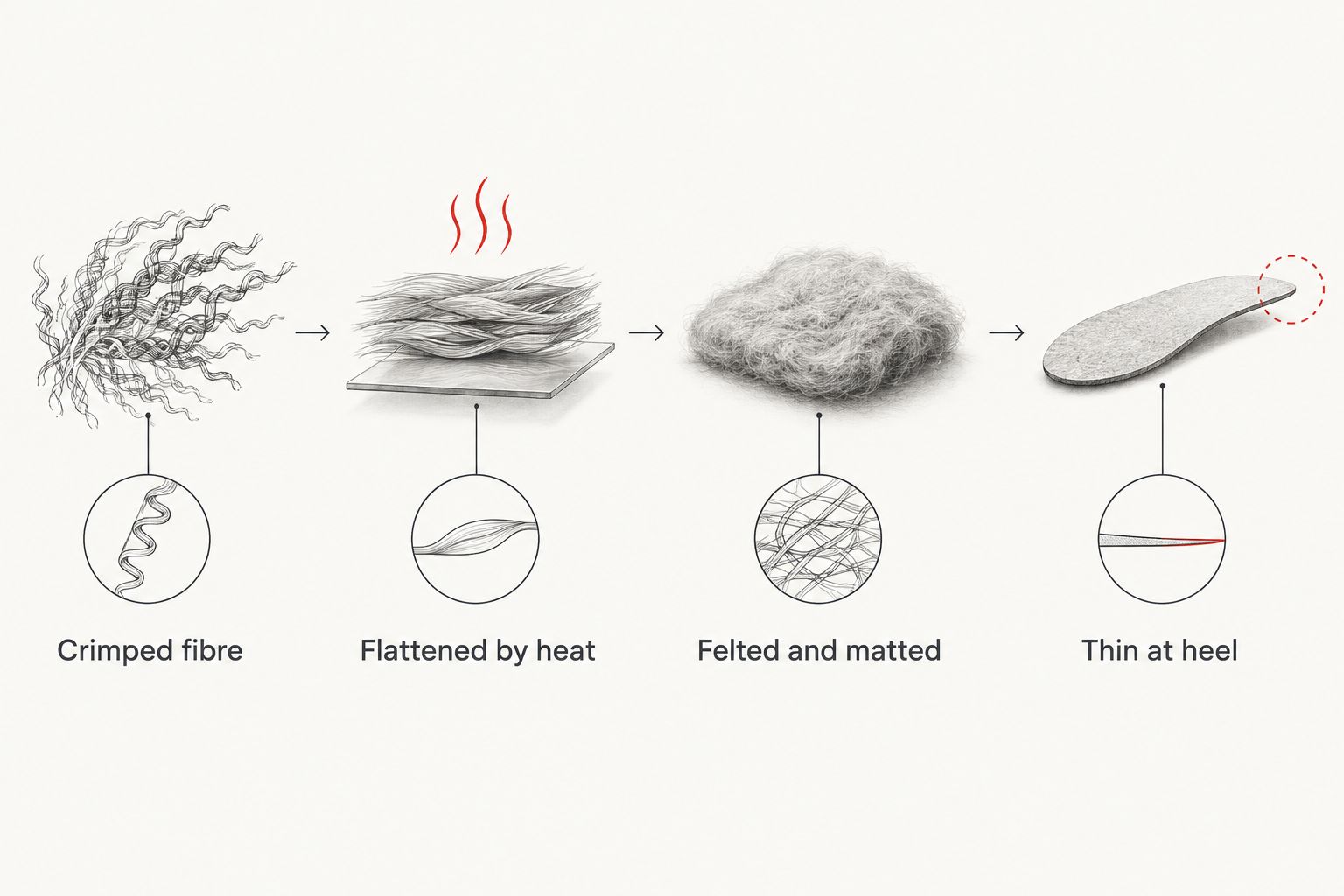
What speeds up warmth loss in wool socks
Most of the warmth a wool sock loses across its working life traces back to one of these habits:
- Washing above 30°C. Heat is the main trigger for felting, and washing wool socks above that temperature can mat a wool-blend sock in a single cycle.
- Tumble drying. The tumbling action combined with residual heat causes the same damage as a hot wash, only faster and with less warning.
- Wearing the same pair two days running. Wool fibre needs time to air out and spring back between wears; back-to-back wear keeps the crimp compressed and slows recovery.
- Rough or stiff boot linings. Constant friction at the heel and toe wears the yarn thin no matter how gently the socks are washed at home.
- Storing socks damp. A damp sock balled up in a drawer or gym bag mats under its own weight overnight and can pick up mildew on top of that.
- Low wool-content blends. A sock with only a small percentage of wool has less crimped fibre to begin with, so what little insulating structure exists degrades faster under the same amount of wear.
“Felting, not time on the shelf, is what actually flattens the air pockets that keep a wool sock warm.”
Signs your wool socks have already lost their warmth
Check for these before trusting an old pair on a genuinely cold morning in 2026:
- A shiny, compressed patch at the heel or ball of the foot — a sign the yarn there has been rubbed flat.
- Fabric thin enough that light passes through it when held up to a window.
- The sock loses its shape the second it comes off, instead of holding a rough sock outline.
- Feet feel cold within an hour of putting boots on, in conditions the same socks used to handle without issue.
- The wool feels stiff or board-like after washing rather than springy — a clear sign of felting.
Can you restore warmth to old wool socks?
Some warmth can be restored, though felted wool never fully un-felts. Gently brushing a wool sock with a soft clothes brush can lift some of the crimp back up and fluff the surface fibres, and light steaming — without direct heat contact — can loosen slightly matted patches.
A worn heel or toe needs a different repair. Darning replaces the abraded yarn rather than trying to restore what's already gone, and it's the more reliable fix of the two. Darning a wool sock at the first sign of thinning can extend its warm working life by a season or more, rather than waiting for an actual hole to appear.
How long do wool socks stay warm before they need replacing?
Wool socks stay warm for as long as the fibre keeps its crimp and the heel and toe stay intact — there's no fixed age at which a pair automatically stops working. A pair washed correctly and rotated with at least one other pair can stay warm through several winters of use; a pair machine-dried every week can lose real warmth within a single winter.
Should you replace wool socks every winter?
No — replacing wool socks every winter isn't necessary if they still hold their shape and show no thin patches at the heel or toe. Check each pair for felting and wear each autumn before buying replacements, rather than replacing on a fixed yearly schedule regardless of condition.
Choosing wool socks that hold their warmth longer
Denser knits generally hold warmth longer under daily wear, simply because there's more wool fibre per stitch that has to felt through before the sock actually thins out. The Ultra Warm Finnish Wool Socks from Nordic Sock Company use a thicker knit built for exactly that kind of daily use through a full 2026 winter, while Nordic Sock Company's lighter Norwegian Fjord and Swedish Lagom ranges suit anyone who prefers to rotate several pairs through the week rather than reaching for one pair on repeat.
Rotation matters more than most people expect. Two similar pairs worn on alternate days will each spend a day resting and springing back between wears, and that rest is part of what keeps wool socks warm well past their first winter.


FAQ
Why do my wool socks feel less warm than when I bought them?
Wool socks feel less warm after felting flattens the crimped fibres that normally trap air, usually caused by a hot wash or a tumble dryer rather than simple age. Abrasion at the heel and toe has the same effect by wearing the yarn thin.
Does washing wool socks reduce their warmth?
Washing wool socks above 30°C or drying them on heat reduces their warmth by felting the fibres. A cool wash and flat, air drying keeps the crimp intact and the socks warmer for longer.
Can you restore warmth to old wool socks?
You can partly restore warmth to old wool socks by brushing the surface to lift the fibre and darning any thin patches at the heel or toe. Fully felted wool, though, never returns to its original loft.
How long do wool socks stay warm before they need replacing?
Wool socks stay warm for as long as the fibre keeps its crimp, which can mean several winters with correct washing and drying. There's no fixed age — thinning at the heel or a matted feel are the real signals to replace a pair.
Is merino wool warmer than regular wool as socks age?
Merino wool holds its crimp slightly better than coarser wool blends because the fibre is finer and more elastic, so merino socks tend to felt more slowly under the same wash routine. Both still lose warmth if washed hot or tumble dried.
Do thicker wool socks lose warmth slower than thin ones?
Thicker wool socks generally lose warmth slower than thin ones because there's more fibre per stitch to felt through before the insulating layer is gone. A thin wool sock reaches the felted, low-warmth stage faster under the same wear.
Can pilling wool socks still keep feet warm?
Pilling wool socks can still keep feet warm if the pilling is only on the surface and the heel and toe are intact. Pilling combined with a thin or shiny heel means the sock has already lost most of its insulating structure.
One last thing
The heel is where warmth disappears first, not the cuff or the leg — that's the part rubbing against a boot with every step, and it's the part worth checking before writing off a whole pair. Hold a suspect sock up to a window: if light comes through the heel more than anywhere else, the fibre there has already thinned past the point of trapping much air, no matter how new the sock still looks everywhere else.